Sudhana at Borobodur – In the Gandhavyuha Sutra (Chapter 39 of
the Avatamsaka Sutra), Sudhana the Youth travels extensively in his search
for anuttara-samyak-sambodhi, supreme perfect enlightenment, and he meets with 52
dharma teachers. The ancient Indonesian monument of Borobodur includes 460 reliefs
depicting the entire sequence of his travels. While many of these have been badly
eroded over time, they nevertheless constitute an artistic tour-de-force – some of the
finest carvings available from ancient Indonesia.
If you are a tourist visiting Borobodur today, you would be given roughly one hour to view
the entire monument. These documentary videos by Walid Haddad give you a much more
relaxed tour – it’s somewhat of a meditative experience. The videos are each approximately
one hour in length, and “are a remarkable feat of dedicated story-telling” – per the summary
on dharmadocumentaries.net. There is one notable difference between the Gandahavyuha Sutra and the reliefs at Borobodur: at Borobodur, Sudhana the Youth is depicted as having a “retinue” of servants who travel with him – something he is missing in the Sutra itself. This was probably poetic license on the part of the aristocrats who commissioned the friezes.
These YouTube videos are available through dharmadocumentaries.net. On September 13,
we will be screening videos 1 and 2 out of 9.
Anathapindika, Foremost Male Benefactor and Bhadda Kundalakesa – The Debating Ascetic are animated
films produced by the San Fran Dhammaram Temple.
Anathapindika (Sudatta): Foremost Male Benefactor – Hajime Nakamura was a professor at Tokyo University whose academic specialty was the life
of the historical Buddha. In his book “Gotama Buddha” he relates that Sudatta was probably a real historical person, although the stories
told about him are perhaps not fully accurate. The monastery at the Jetavana grove in the city of Savatthi in ancient India is reputed to
have been the central, core founding monastery of the Buddhist tradition. Sudatta is said to have purchased the Jetavana grove from prince
Jeta by laying out a quantity of gold so large that the gold coins physically covered the entire surface of the ground.
Whether historically true or not, it makes for an interesting story.
Bhadda Kundalakesa – The Debating Ascetic – This is a story of a woman in ancient India who becomes proficient in debate,
and is able to out-debate all of the non-Buddhist philosophers of her day.
Tibet: History, Culture and Religion is a 24-part series from The Great Courses. Modules 21-24 in the series are as follows:
21. Tibetan Diaspora: Hardship and New Realities – Today, more than 100,000 Tibetans have fled Chinese rule and live in at least 40 countries around
the world. Learn about the issues faced by Tibet and its government in exile—the Central Tibetan Administration—as Tibetans in the diaspora feel their connection
to their homeland weaken as time passes.
22. How Tibetan Art Keeps Heart and Soul Alive - Learn how Tibetan artists have kept their religious art alive under Chinese rule. Explore the thangka paintings often depicting mandalas, bodhisattvas,
or lineages of teachers. You’ll also learn about iconography on altars and some of the most common Tibetan Buddhist symbolism in art, including the four harmonious
friends, wheel of existence, eight auspicious symbols—and the swastika.
23. A Future Tibet Without the Dalai Lama? - Since 2008, foreign journalists have not been allowed into central Tibet unless accompanied by
government-approved guides. Pictures of the Dalai Lama and singing of the national anthem are officially banned. And yet, it is the Dalai Lama who has kept
the world’s attention on the plight of Tibet. Consider some of the existential issues that could arise after the passing of the fourteenth Dalai Lama.
24. The History of Tibet in 24 Questions - Learn about The Tibetan Book of the Dead and its influence on the U.S. counterculture in the 1960s,
as well as other cultures around the world. You’ll discover why some academic authorities say the book is not really Tibetan, a book, or about death. Instead,
it is an odd jumble of spiritualism mixed with pseudo-psychology that would seem almost bizarre to most Tibetan Buddhists. The course then concludes with a
summary question and answer.
Tree and Serpent: Early Buddhist Art in India. This video is a discussion of an exhibit of early Buddhist Art from India at the
Metropolitan Museum of Art. It is being screened courtesy of the Metropolitan Museum of Art.
Beyond Boundaries: Buddhist Art of Gandhara. This documentary is a tour of an exhibition of Gandharan Buddhist art at the
Berkeley Art Museum of Berkeley University with historical discussion and commentary. It is being screened courtesy of the
Berkeley Art Museum and Pacific Film Archive.
Buddha’s Birthday Party will start at 1:00 PM, to be followed by the videos.
Buddhist monks of the Theravadin tradition walked for peace from Texas to Washington DC. Their pilgrimage started on October 26, 2025
and ended on February 11, 2026. They were led by Bhikkhu Pannakara, an ethnic Vietnamese Theravada forest monk. They are seeking to
promote peace, national healing, unity and compassion. Despite harsh North American weather conditions, they covered a total of 2,300
miles on foot – partly barefoot, and partly with only one meal per day. They were greeted by large crowds and arrived by their projected
end date despite bitter cold freezing temperatures.
Buddhist monks in the Theravada forest tradition are often held in high regard in Zen circles because of their noted taste for austerity
and meditative discipline. Among the wide variety of Buddhist sects, they are probably the ones closest to the original practices of the
historical Buddha.
Tibet: History, Culture and Religion is a 24-part series from The Great Courses. Modules 17-20 in the series are as follows:
17. The Festivals of Tibet's 354 Day Calendar - In addition to the many lesser festivals celebrated throughout Tibet, nearly everyone celebrates
the Tibetan New Year, Losar, with dancing, visiting family, a home altar, special foods, and
honoring personal religious traditions. Learn how Tibetans are now using not Losar to protest
Chinese rule by quietly not celebrating the holiday, even as more traditional forms of protest have been outlawed.
18. The Dalai Lamas' Mysterious Lives and Deaths - Tenzin Gyatso—the fourteenth and current Dalai Lama—describes himself as a “simple monk” even though
he has been awarded the Nobel Peace Prize for trying to broker peace between his homeland and the Chinese.
Discover the religious and political contexts surrounding the Dalai Lama tradition, and why the tulku
tradition is so important to him and all the Dalai Lamas who came before him.
19. Tibet's Old Traditions Enter a New Century - The monk Gendun Drub, a disciple of the founder of the Gelug tradition, became known as the
first Dalai Lama. Tibetan Buddhists have viewed every Dalai Lama since as reincarnations of
this first master. Learn about the significant geo-political developments faced by the thirteenth
Dalai Lama and how the current Dalai Lama was identified as the reincarnation of Gendun Drub.
20. World War II, China, and the 14th Dalai Lama - In October 1950, the newly formed communist People’s Republic of China sent troops into Tibet,
and the Dalai Lama formally assumed office a little more than a month later, at age 15. Discover
the young Dalai Lama’s numerous attempts at peace making, including meeting with Mao Zedong in Beijing,
and why he eventually fled Tibet to lead his government while in exile in Dharamsala, India, where he lives still.
Tibet: History, Culture and Religion is a 24-part series from The Great Courses. Modules 13-16 in the series are as follows:
13. Tibetan Buddhism's Revival – Three monks who fled to Amdo after the assassination of the last Tibetan emperor in the ninth century of the Common Era were crucial to Tibetan
Buddhism. The period known as “the later Dissemination” allowed for a comeback of the religion even 200 years later. 14. Tibet's Reincarnation Tradition: The Tulkus – The head of the Karma Kagyu tradition of Tibetan Buddhism is a figure known as the Karmapa. All Karmapas are considered to be
reincarnated masters whose lineage stretches back to the original Karmapa. 15. Sakya Buddhism - 1000 Years of Family Rule – the Sakya school has been grounded in family lineage for the past many centuries; all leaders are part of the Khön family. Learn
about the many political and religious changes Tibet has seen during this family’s rule. 16. Tibetan Nomads Under Chinese Centralization – A large percentage of Tibetans have lived as nomads for thousands of years. Discover how decisions by the Chinese authorities are
affecting this lifestyle in part by limiting traditional patterns of migration.
Greek & Persian Influence on Early Buddhism is a documentary discussing the influence of
Gandharan monks of Greek/Persian extraction on early Buddhism. The “Shakyas” derive their name
from the same etymological root as the “Shah” of Iran, and “Shah” means warrior. The family of
Shakyamuni Buddha was not originally part of the Hindu caste system, but a warrior clan originating
somewhere in Persia. It looks as if Buddhist scriptures were first put into writing by Buddhist monks of
Greek extraction. We are all familiar with the Greek influence on Gandharan art – and thereby on
Buddhist art throughout Asia. However, based on archeological discoveries in Pakistan in the 1990s it
looks as if the very earliest Buddhist writing also had its origins in Gandhara. Research done by
Richard Salomon on some ancient birchbark scrolls found in a ceramic jar on the Pakistan antiques
market reveals that the ancient writings were executed in the now-extinct Gandhari language.
Ajahn Sona of the Birken Forest Monastery in Canada is a Theravadin Buddhist monk in the line of
Ajahn Chah. This expertly crafted documentary is his creation.
Tibet: History, Culture and Religion is a 24-part series from The Great Courses. Modules 9-12 in the series are as follows:
9. Tibetan Tantra and Taboo – Examine the differences between the sutras and tantras of Tibetan Buddhism.
10. The Good Eating and Fun of Tibetan Cuisine – Because of the difficulty of growing vegetables at such high altitude, meat and animal products are important staples of a Tibetan diet.
11. What Makes Tibetan Buddhism Different – Learn how the establishment and spread of Tibetan Buddhism was influenced by the men known as the “Three Dharma Kings” — Songtsen Gampo, Trisong Detsen, and Ralpachen.
12. Tibetan Buddhism’s Oldest Sect: Nyingma – Discover the teachings and practices of the Nyingma tradition, Tibetan Buddhism’s oldest sect, and the one most closely associated with Padmasambhava.
Tibet: History, Culture and Religion is a 24-part series from The Great Courses. Modules 5-8 in the series are as follows:
5. Tibetan pre-history in folksongs and tales. Learn about the Tibetan Epic of Gesar, considered to be the longest piece of literature in the world, at an estimated one million lines.
6. How the Tibetan Language Invented an Empire – The Tibetan language did not exist in standard written form until the seventh century when King Songtsen Gampo directed its creation so he could better give orders
7. The Buddha and the Four Noble Truths – Discover how the Buddhist religion and philosophy first began with a prince named Siddhartha who wanted to see the world outside his palace. Following the middle path, Siddhartha achieved enlightenment.
8. Christians, Muslims and Bonpos of Tibet – Learn about the most widespread religion among non-Buddhist Tibetans, Bön, and discover the complex relationship between the two religions.
Tibet: History, Culture and Religion is a 24-part series from The Great Courses. The first
four modlues are as follows:
1. Life at the Roof of the World – Tibet is presented as a complex and multi-faceted civilization, not conforming to existing stereotypes.
2. When the Dalai Lama Broke with China – After entering into many negotiations with China, the Dalai Lama felt that he had not choice but to lead his government into exile.
3. The Birth of Buddhism’s Powerful Gelug Sect – The Gelug sect was founded in 1359 by a monk named Tsongkhapa, the first of 100 leaders of the sect. The New Kadampa Tradition is
a variant of the Gelug sect and opposes the traditions of the Dalai Lama.
4. The Zhang Zhung and Yarlung Dynasties – Mogao cave 17, known as the Library cave at Dunhuang, contains texts which remain untranslated and undeciphered, but contain information regarding early Tibetan dynasties.
Zen for Nothing is a documentary about the Japanese Soto Zen Monastery Antaiji. Antaiji has its own small rice paddy
and forest. Despite its rural location, it “rhymes” with the First Zen Institute of America – it feels a lot like
the First Zen Institute. We see Antaiji in spring, summer, autumn and winter. Zen for Nothing partially
resembles the film Into Great Silence, in that it provides portraits of several of the participants, including a
Zen Master who likens himself to an academic professor.
The Monk and the Gun is a comedy surrounding the decision on the part of the Bhutanese King in
2006 to turn Bhutan into a democracy. Not everybody welcomes this change. The “Gun” in the movie is an old American
Civil War weapon with a special serial number. An old Lama asks his disciple to acquire a couple of guns because he
wants to “Set things right” on the occasion of Bhutan’s transition to democracy. It’s not clear exactly what he
means by this. At the same time, an American gun merchant is after the gun because of its value as a collector’s
item and is prepared to trade a pair of AK47s for it. The film has a surprise ending.
Understanding Japan – A Cultural History is a 24-lecture series discussing the development of
Japanese culture over the last two millennia. This series is being taught by Mark Ravina, a professor at Emory University.
On Friday, March 6, we will continue with lectures 3, 4, 5 and 6:
3. The Emergence of the Ritsuryo State
4. Aspects of the Japanese Language
5. Early Japanese Buddhism
6. Heian Court Culture
Dying to Know: Ram Dass Timothy Leary is a documentary about a pair of Harvard psychology
professors credited with kick-starting America’s flirtation with psychedelic drugs during the 1960s. For some
Americans, this indirectly led to a deeper, more substantial interest in eastern religion. Timothy Leary had no
intention of involving Harvard undergraduates in his LSD experiments, but eventually, one of them became an
experimental subject, and that got Professor Leary fired. Later, Timothy Leary did hard time in prison on drug
charges, and Richard Nixon proclaimed him to be America’s “Public enemy number one.” Richard Alpert departed from
Harvard at the same time as Leary, and later traveled to India where he became a disciple of Neem Karoli Baba
and took the name “Ram Dass.” He also authored the book “Be Here Now.” Unusual and complex individuals, the two
of them remained lifelong friends. 94 Minutes. Licensed from Kino Lorber, www.kinolorber.com.
Sacred Texts of the World is a 36-lecture series that discusses a broad range of religious texts of
seven major religions. We are closing out this series with the last two lectures:
Understanding Japan – A Cultural History is a 24-lecture series discussing the development of
Japanese culture over the last two millennia. This series is being taught by Mark Ravina, a professor at Emory University.
We will be starting this series with the first two lectures:
1. Japan – A Globally Engaged Island Nation
2. Understanding Japan Through Ancient Myths
The Medicine Buddha is a documentary about reviving the traditional Mongolian healing arts – ancient
practices suppressed during sixty years of communist rule. Buddhist mantras and meditative practices help to counterbalance
modern stress, pollution and crowded cities, and offer an alternative to modern day mind-pollution. This film is a
cinematic portrait of Khamba Lama Natsagdorj, a physician trained in western medicine and also a leading Mongolian
Buddhist and head of the Manba Datsan Monastery. He successfully bridges faith and science, and uses traditional
Mongolian healing arts to promote good health in body and mind – the best possible preventive medicine. It is hard
to believe that Mongolia, which today has the smallest population density of any nation on earth, once ruled an empire
that spanned more than half the Eurasian continent. In the film, Khamba Lama Natsagdorj pays a visit to the rural
village where he grew up, amidst Mongolian cow-boys herding horses, cattle and yaks across the wild, rugged landscape.
Narrated in English by Ben Kingsley. 110 Minutes. This film is being licensed through Shoreline Entertainment. www.slefilms.com.
Sacred Texts of the World is a 36-lecture series discussing a broad range of
religious texts of seven major religions. On Friday, July 12, we will be screening lectures 31-34 in
the series, pertaining to the Qur'an, Hadith and Sufism, Baha'i scriptures and the abandoned scriptures of the ancient Egyptians and Mayans. Our professor for this course is Dr. Grant Hardy.
Dr. Hardy is Professor of History and
Religious Studies and Director of the Humanities Program at the University of North Carolina at
Asheville. He earned his B.A. in Ancient Greek from Brigham Young University and his Ph.D. in Chinese
Language and Literature from Yale University. Professor Hardy has received a wealth of awards and
accolades for both his teaching and his scholarship.
(31) Holy Qur'an
(32) Hadith and Sufism
(33) Related Traditions -- Baha'i Scriptures
(34) Abandoned Scriptures – Egyptian and Mayan
Doomsday Book is three science fiction movies, one of which concerns a robotic monk in a
Korean Zen monastery. Robots of this model have achieved full human consciousness, and this particular robot has
attained enlightenment. However, robots of this model are now considered dangerous, and the corporation that created
them wants to see them all destroyed. This film is laden with metaphors about Zen. Do they really want to destroy the
robot because he is a particular model, or do they want to destroy him because he is a Zen master? Spoken in Korean
with English subtitles. Doomsday Book is being screened courtesy of Well Go USA Entertainment, www.wellgousa.com. 40 Minutes.
Seven Wonders of the Buddhist World is a PBS film, and is partly a travelogue discussing seven
historical and modern Buddhist sites in India, Nepal, Sri Lanka, Cambodia, China and the United States. It is also
includes interviews with academic scholars and Buddhist practitioners, with an emphasis on traditional Buddhist belief
and practice, and the relevance of Buddhism to the modern world. This film is being licensed through PBS, www.pbs.org. 70 Minutes.
Ai-Un Hugo Makibi Enomiya-Lassalle: Bridge Builder Between Zen and Christianity is a
documentary about the life of the German Jesuit priest and Zen instructor Hugo Enomiya-Lassalle, 1898-1990. He was
one of the foremost teachers to embrace both Roman Catholic Christianity and Zen Buddhism. Serving in the German
Army during World War I, he joined the Society of Jesus shortly after the war ended, and became an ordained Jesuit
priest in 1927. He traveled to Japan as a missionary in 1929 and was Vicar of Hiroshima on August 6, 1945 when the
atomic bomb was detonated over that city. He was badly wounded by the blast. After the war, he was instrumental in
building the Hiroshima Memorial Cathedral for World Peace. He started studying Zen with Harada Daiun Sogaku in 1956
and in 1958 published: Zen A Way to Enlightenment. Following Harada’s death, he studied with Yamada Koun, who was
enthusiastic about Zen as a form of Christian practice. In the late 1960s, he became a certified Zen instructor and
was given the title “Roshi” by Yamada Koun Roshi. After 1968 he spent most of his time teaching Zen in Europe. His
interesting and unusual life is explored in detail in this documentary. This film is being screened courtesy of Loyola
Productions Munich GmbH. www.lp-muc.com.
Spoken in German with English subtitles. 110 Minutes.
Admission is free.
Sacred Texts of the World is a 36-lecture series discussing a broad range of
religious texts of seven major religions. On Friday, July 12, we will be screening lectures 27-30 in
the series, pertaining to the biblical Letters, Apocryphal Gospels, Mormon scriptures and Islam. Our professor for this course is Dr. Grant Hardy.
Dr. Hardy is Professor of History and
Religious Studies and Director of the Humanities Program at the University of North Carolina at
Asheville. He earned his B.A. in Ancient Greek from Brigham Young University and his Ph.D. in Chinese
Language and Literature from Yale University. Professor Hardy has received a wealth of awards and
accolades for both his teaching and his scholarship.
(27) Letters and Apocalypse
(28) Apocryphal Gospels
(29) Related Traditions -- Mormon Scriptures
(30) Islam and Scriptural Recitation
The Oracle: Reflections on Self is a documentary about the Tibetan Oracle. While the official Tibetan
Oracle provides advice from important Buddhist deities to the Dalai Lama, many small Tibetan villages
have their own oracles, providing advice from local gods or spirits. The Oracle is a Buddhist adaptation
of traditional shamanistic practices associated with the Bon religion of Tibet. So widespread was
Tibetan belief in the Oracle as a source of advice to the Tibetan government that it may have delayed
the formation of a Tibetan parliament. 52 Minutes.
Sleepwalking Monglia is a documentary about the Kalachakra initiation ceremony performed by the Dalai
Lama in Mongolia. Buddhist teaching, politics, history, group dynamics and competition with Evangelical
Christians are presented in detail. Mongolia at the start of the 20th century was a highly stratified
agrarian society with serfs owned by the aristocracy and by the monasteries. With the fall of the Qing
dynasty in 1911, Mongolian independence from China was declared the Bogd Khaan, the highest Buddhist
prelate in the nation. However, real Mongolian independence from China was only guaranteed by Stalin
and the Mongolian communists, who unleashed a fierce anti-Buddhist persecution. This film focuses on
efforts on the part of Mongolian Buddhists to rebuild their tradition. 96 Minutes.
Would you like to live on automatic pilot, with a mind like Velcro that attaches to anything it encounters? Mindfulness,
on the other hand, helps us to calm and center the mind and stay present. Our own minds magnify the impact of negative
events by a factor of 100, prolonging and deepening suffering. Real suffering is often optional – it’s what happens when
our minds ruminate and endlessly remain stuck in negative emotional states. Mindfulness – Be Happy Now shows how we can
free our minds by remaining focused. This film consists of a series of interviews with practitioners in the field of
Mindfulness, with an emphasis on the teachings of Thich Nhat Hanh.
Admission is free.
Sacred Texts of the World is a 36-lecture series discussing a broad range of
religious texts of seven major religions. On Friday, January 18, we will be screening lectures 19-22 in
the series, pertaining to Jain, Confucian, neo-Confucian and Daoist scriptures. Our professor for this course is Dr. Grant Hardy.
Dr. Hardy is Professor of History and
Religious Studies and Director of the Humanities Program at the University of North Carolina at
Asheville. He earned his B.A. in Ancient Greek from Brigham Young University and his Ph.D. in Chinese
Language and Literature from Yale University. Professor Hardy has received a wealth of awards and
accolades for both his teaching and his scholarship.
(23) The Three Caverns of Daoist Scriptures
(24) Related Traditions -- Shinto and Tenrikyo
(25) Christian Testaments Old and New
(26) Gospels and Acts
Jnani -- The Silent Sage of Arunachala is a feature length documentary focusing on the
life and teachings of Ramana Maharshi, regarded by many as one of the greatest spiritual masters of modern times.
Jnani was filmed in and around the Ramanashramam and the Arunachala Mountain in Tiruvannamalai, Tamil Nadu, India.
Ramana Maharshi’s teachings, which lead to self-knowledge, are clearly explained by foremost experts and writers
on the sage's philosophy, including David Godman, Michael James and Sri V. Ganesan, the great-nephew of Sri Ramana
Maharshi. 80 Minutes. This film is being screened courtesy of Jean R. Dedieu and Cinefx Productions,
Cinefx Productions (www.jnani.tv).
Ramana Maharshi: Silence is the most potent form of work. However vast and emphatic the sastras may be, they fail
in their effect. The Guru is quiet and peace prevails in all. His silence is more vast and more emphatic than all
the sastras put together.”
Himalaya was filmed over seven months in the remote Dolpo region of Nepal, It tells the story of
a generational struggle for the leadership of a tiny mountain village between its proud old chief and a headstrong young
caravanner. The balance of power shifts uneasily as they make their annual salt trek across the Himalayas. A visually
striking and spiritually captivating portrait of life in one of the world's most extraordinary places, Himalaya is both intense drama and a gorgeous tapestry of the fast disappearing traditions of
Tibetan life. A huge box office hit worldwide, Himalaya remained on the Variety top film box office chart for over six months
and was nominated for an Academy Award for Best Foreign Film. It is a classic film with universal appeal. This brand
new transfer has been remastered in high definition from Kino Classics. 104 Minutes. Spoken in Tibetan with English subtitles.
This film is being licensed through Kino Lorber, http://www.kino.com.
Admission is free.
Sacred Texts of the World is a 36-lecture series discussing a broad range of
religious texts of seven major religions. On Friday, January 18, we will be screening lectures 19-22 in
the series, pertaining to Jain, Confucian, neo-Confucian and Daoist scriptures. Our professor for this course is Dr. Grant Hardy.
Dr. Hardy is Professor of History and
Religious Studies and Director of the Humanities Program at the University of North Carolina at
Asheville. He earned his B.A. in Ancient Greek from Brigham Young University and his Ph.D. in Chinese
Language and Literature from Yale University. Professor Hardy has received a wealth of awards and
accolades for both his teaching and his scholarship.
(19) Related Traditions – Jain Scriptures
(20) Five Confucian Classics
(21) Four Books of Neo-Confucianism
(22) Daoism and the Daodejing
Shaolin Wheel of Life features twenty ordained Buddhist monks from China’s renowned Shaolin
Temple. It relays the legendary tale of a time when the Shaolin monks were brought to the imperial palace to protect
the emperor, and how they saved him from an invading warlord. Later, the emperor betrayed their trust and turned against
them. Ultimately, five young monks emerge to continue the tradition and perpetuate the “Wheel of Life.” During the
performance, the monks leap, swivel, swirl and strike in an extended kung-fu wushu performance – a sort-of martial
arts ballet spectacular. All of them are limber, graceful and strong. They are lifted on sharpened spears, break iron
bars on their heads, smash concrete blocks while lying between beds of nails and swords, perform handstands on two fingers
and splinter wooden staffs against their bodies in an amazing display of chi and self-control. The entire performance
is carefully choreographed in a thoroughly professional theatrical production. 90 Minutes, with English subtitles. This
film is being licensed through Park Circus, Inc., (www.parkcircus.com).
Admission is free.
The Tale of the Princess Kaguya is an animated
adaptation of the tenth century Japanese Buddhist/Shinto folk tale The Bamboo Cutter. One day while walking
in the forest, an old, childless woodcutter encounters a glowing bamboo shoot. Inside the shoot is a
thumb-sized baby girl. The old woodcutter takes her home and she is raised by him and his wife. They call
her “Princess,” and she grows into a normal-sized girl of great beauty. She is courted by five royal
suitors, and eventually by the Emperor himself, but reveals to her parents that she comes from the Moon.
She broke the laws of the Moon and was exiled to Earth so that she could experience mortal life. In the end,
the Buddha himself comes to take her back to the Moon. This magical film is our Halloween offering for 2018,
and is being licensed through GKIDS (www.gkids.com). 138 minutes.
Admission is free.
Sacred Texts of the World is a 36-lecture series discussing a broad range of
religious texts of seven major religions. On Friday, September 7, we will be screening lectures 15-18 in
the series, pertaining to Buddhist scriptures. Our professor for this course is Dr. Grant Hardy.
Dr. Hardy is Professor of History and
Religious Studies and Director of the Humanities Program at the University of North Carolina at
Asheville. He earned his B.A. in Ancient Greek from Brigham Young University and his Ph.D. in Chinese
Language and Literature from Yale University. Professor Hardy has received a wealth of awards and
accolades for both his teaching and his scholarship.
(15) Theravada Sutras
(16) Mahayana Sutras
(17) Pure Land and Zen
(18) Tibetan Vajrayana
The Real Shaolin gives an inside look at the real state of Kung Fu training at
Shaolin Temple in China. Shaolin was the home temple of Bodhidharma, and said to be the source of both
Chinese Kung-Fu and also Zen Buddhism. The Bruce Lee and Jet Li Kung-Fu movies have inspired a generation
of Chinese to train in the traditional martial arts – a cottage industry in the nearby city of Dengfeng in
central China. Westerners, although they have trained extensively in Kung Fu studios in Europe and
America, are generally unprepared for the tough, brutally competitive environment at Shaolin. For
Westerners, Kung-Fu is often just a hobby, but China has a large population of poor peasants, for whom
martial arts training may be their ticket to a better life. This skillfully executed documentary holds
the viewer’s attention as it follows the progress of four aspirants: a Chinese teenager competing in
Sanda (Chinese kick-boxing) at the National level, a 19-year old American said to be among the best
westerners ever to train at Shaolin, a 9-year old Chinese orphan and a 29-year old Frenchman. The hard
training required to execute effortless-appearing Kung-Fu moves is brought into focus, along with the
dreams, delusions and physical injuries suffered by the aspirants. In the end, the film is a triumph
of the human spirit.
This film is being licensed through www.RealShaolin.com. 92 minutes.
Admission is free.
The Betrayal starts with a young Buddhist family in Laos. The
father takes a position as leader of a company of CIA-trained guerillas tracking the movements of the
North Vietnamese Army as it works its way down the Ho Chi Minh trail. After the war, the father is
arrested, placed in a communist “re-education” camp and his family is left to fend for themselves.
Escaping across the Mekong river, they enter a refugee camp in Thailand and from there move to America.
In America, they end up in one of the worst slums in Brooklyn, where they are surrounded by filth, gang
violence, drugs, and a youth-culture that disrespects immigrants and parents. When the half-brother of
the film’s central character gets murdered in gang violence at the age of 16, his funeral is conducted by
Buddhist monks. At the end of the film, the family leaves the slums and moves to a small house in a nice
suburban community in New Jersey – in some ways a typical American immigrant success story. The film
frequently references the family’s Buddhist past, as if to say, does American society – despite its
wealth and power – really represent an improvement over the life they left behind in Laos?
This film is being licensed through Kino Smith, (www.Kinosmith.com). 92 minutes.
Admission is free.
Sacred Texts of the World is a 36-lecture series discussing a broad range of
religious texts of seven major religions. On Friday, June 8, we will be screening lectures 11-14 in
the series, pertaining to Hebrew and Buddhist scriptures. Our professor for this course is Dr. Grant Hardy.
Dr. Hardy is Professor of History and
Religious Studies and Director of the Humanities Program at the University of North Carolina at
Asheville. He earned his B.A. in Ancient Greek from Brigham Young University and his Ph.D. in Chinese
Language and Literature from Yale University. Professor Hardy has received a wealth of awards and
accolades for both his teaching and his scholarship.
(11) Oral Torah – Mishnah and Talmud
(12) Related Traditions – Zoroastrian Scriptures
(13) The Three Baskets of Buddhism
(14) Vinaya and Jitaka
Sacred Texts of the World is a 36-lecture series discussing a broad range of
religious texts of seven major religions. On Friday, May 18, we will be screening lectures 7-10 in
the series, pertaining to the ancient Hebrew scriptures. Our professor for this course is Dr. Grant Hardy.
Dr. Hardy is Professor of History and
Religious Studies and Director of the Humanities Program at the University of North Carolina at
Asheville. He earned his B.A. in Ancient Greek from Brigham Young University and his Ph.D. in Chinese
Language and Literature from Yale University. Professor Hardy has received a wealth of awards and
accolades for both his teaching and his scholarship.
(7) Judaism -- People of the Book
(8) Five Books of Torah
(9) Prophets and Writings
(10) Apocrypha and Dead Sea Scrolls
Golden Kingdom tells the story of a group of small boys in an
isolated Buddhist monastery/orphanage in Myanmar (Burma) during a sudden military insurgency. We see
the world from the point of view of the boys themselves, and we can feel their confusion. The serene and
mysterious countryside has become dangerous. Gunfire can be heard in the distance, and people are getting
killed. The adult monk who was their preceptor has disappeared. The boys are without food, are confused
and are at a loss to figure out what to do, where to go or who to talk to. They must fend for themselves.
Golden Kingdom is surreal, and accompanied by ghosts – or perhaps just wild dreams.
This is the first international feature film shot in Myanmar since its opening to the outside world.
Spoken in Burmese with English subtitles.
This film is being licensed through Kino Lorber, (www.Kino.com). 103 minutes.
Admission is free.
Miss Hokusai tells the story of the daughter of one of the most famous artists in world
history. While all of Edo flocks to see the work of the painter and printmaker Katsushika Hokusai, his daughter,
O-Ei works tirelessly behind the scenes to help create the artworks sold under her father’s name. She also cares
for her sickly and blind younger sister. This is partly a story about Hokusai, partly about O-Ei, and partly
about the business of being an artist living in early 19th century Edo. There is some Buddhism in the film, but
it is almost incidental – some of the artistic commissions deal with Buddhist themes. We see Hokusai in his
studio with O-Ei working as his studio assistant. She is definitely a woman ahead of her time, and an
accomplished artist in her own right. She is pursued by several suitors, but suffers no fools. Miss Hokusai is
the First Zen Institute’s offering for New York’s Asian Art Week 2018. Spoken in English.
This film is being licensed through Gkids, Gkids (www.Gkids.com). 180 minutes.
Admission is free.
Sacred Texts of the World is a 36-lecture series discussing a broad range of
religious texts of seven major religions. On Friday, February 9, we will be screening lectures 3-6 in
the series, pertaining to the Hindu and Sikh traditions. Our professor for this course is Dr. Grant Hardy.
Dr. Hardy is Professor of History and
Religious Studies and Director of the Humanities Program at the University of North Carolina at
Asheville. He earned his B.A. in Ancient Greek from Brigham Young University and his Ph.D. in Chinese
Language and Literature from Yale University. Professor Hardy has received a wealth of awards and
accolades for both his teaching and his scholarship.
(3) What is Heard -- Upanishads
(4) What is Remembered – Epics
(5) Laws of Manu and Bhagavad-Gita
(6) Related Traditions – Sikh Scriptures
Walk With Me is a documentary centered on Plum Village, a
Buddhist community located in southwest France and run by the Vietnamese Buddhist monk Thich Nhat
Hanh. It’s somewhat similar to the film Into Great Silence, about life in a Catholic Carthusian
monastery. The film has a meditative quality to it, with great cinematography and not very much
dialogue or music. It is more of a portrait of the Plum Village community as a whole rather than
any individual in particular. Some of the participants are ordained Buddhist monks and nuns, who
have surrendered all their possessions, live on small stipends and have taken strict vows of celibacy.
Others are laymen and laywomen attending events at Plum Village for a few days or a few months, and
some hail from the United States. Many are naturalized citizens of France of Vietnamese extraction.
The film includes a road trip to New York City and the west coast of the United States. Spoken in
English, French and Vietnamese with English subtitles.
This film is being licensed through Kino Lorber (www.Kino.com). 93 minutes.
Admission is free.
The Science of Mindfulness: A Research-Based Path to Well-Being is a 24-lecture series on centered on research findings surrounding mindfulness and meditation.
This screening is going to conclude the series with modules 23 and 24:
(23) Growing Up is not Easy -- Facing Impermanence
(24) Toward a Science of Wisdom
Dr. Ronald D. Siegel is an Assistant Clinical Professor of Psychotherapy at the Harvard Medical School and an Adjunct Clinical
Professor of Psychiatry at the University of Massachusetts Medical School. He is the author or editor of a number of important
publications, including: The Mindfulness Solution: Everyday Practices for Everyday Problems.
Sacred Texts of the World is a 36-lecture series which discusses a broad range of religious texts of
seven major religions. The professor, Grant Hardy, is a professor of History and Religious Studies at the University of
North Carolina at Asheville. Tonight we are screening the first two episodes this series:
(1) Reading Other People's Scriptures
(2) Hinduism and the Vedas
These films are being screened
courtesy of The Teaching Company, http://www.thegreatcourses.com.
On Meditation offers personal testimonials about the value of meditation.
This absorbing documentary discusses the real, practical value of the quiet, private, interior practice of meditation.
Participants include David Lynch, Giancarlo Esposito, Peter Matthiessen, The Venerable Metteyya, Russell Simmons,
Congressman Tim Ryan, Elena Brower, Gabrielle Bernstein, Sharon Salzberg, Mark Epstein & Marlene Shechet. It is
unexpected and inspiring to hear a U.S. Congressman talk about the value of meditation. 69 Minutes.
The Auspicious Seventh Lunar Month offers a different take on Chinese “Ghost Month.” Is the
Seventh Lunar Month a time of fear? A time to avoid hungry ghosts and placate the gates of Hell? A time to avoid
travel and business dealings? During Buddha's life, the 7th lunar month was when his disciples emerged after a
three-month period of seclusion enforced by the rainy season. During the rainy season, poisonous snakes made traveling
to beg for alms dangerous. The retreat allowed the Buddha’s disciples to attain great progress in their Dharma practice;
Hence the completion of the summer retreat on the 15th day of the seventh lunar month was considered an auspicious
occasion. This film comes to us from the Taiwan-based Tzu Chi Culture and Communications Foundation, founded by
Buddhist Nun Dharma Master Cheng Yen, who is featured in the film. This is our Halloween offering for 2016. Spoken in
Mandarin with English Subtitles. 48 minutes.
Christianity was introduced to Japan with the arrival of the Jesuit priest St. Francis Xavier from Spain in 1549. The religion gradually became quite popular and
at one time claimed around 200,000 adherents, including 86 Daimyo converted between 1553 and 1620, with many converts centered on the island of Kyushu near Nagasaki.
However, the shogun Toyotomi Hideyoshi became alarmed by the growing influence of the Christian Daimyo, some of whom forced conversions on their subjects and also
received direct military support from the Spanish and Portuguese in the form of muskets and gunpowder. In 1615, a Franciscan emissary of the Viceroy of New Spain
asked the Shogun for land to build a Spanish fortress and this deepened Japan's suspicion against Catholicism. The statement on the "Expulsion of all missionaries
from Japan" was drafted by Zen monk Konchiin Suden and issued in 1614 under the name of the shogun Tokugawa Hidetada. In the same year, the bakufu required all
subjects of all domains to register at their local Buddhist temple; this would become an annual requirement in 1666, cementing Buddhist temples as instruments of
state control. The Tokagawa Shogunate, Japan’s military government, used fumi-e to reveal practicing Catholics and sympathizers. Fumi-e were pictures of the Virgin
Mary or Christ. People reluctant to step on the pictures were identified as Christians and taken to Nagasaki. If they refused to renounce their religion, they were
tortured; those who still refused were executed. Silence is set during the period when the heavy persecution of Christians is well underway.
It is a disturbing film centered on the activities of three Jesuit missionaries. 160 minutes.
Tai Chi has been described as “Zen in motion.” The Professor, Tai Chi’s Journey West describes the life and work of Cheng Man-Ching,
who brought Tai Chi from Taiwan to New York during the 1960s. The film features testimonials from many of Cheng Man-Ching’s senior students, some of whom have
gone on to become Tai Chi instructors. He practices the “internal martial art” with grace and power. The film gives a pretty good overview of Tai Chi Chuan,
but it is not really an instructional video, rather, it’s more of a biographical documentary. There is included an “extra” clip of Cheng Man-Ching performing
the 37 posture Yang-style short form, which we are going to screen. The Professor, Tai Chi’s Journey West details the cross-cultural transplantation of this gem of Chinese culture from China to America, and is an important historical resource.
This film is being licensed through First Run Features, http://www.firstrunfeatures.com; 80 minutes.
Moving From Emptiness is a presentation of the life and art of Alok Hsu Kwang-Han. His art is a combination of Zen, Chinese
ink painting and abstract expressionism. Can you paint the sound of one hand clapping? Can you paint the meaning
of Bodhidharma’s coming from the west? Does a dog have Buddha Nature? Can you paint that? Alok Hsu Kwang-han
demonstrates both a unique art form and a very unusual, highly creative approach to Zen koans. Using rice paper
and mostly black ink, he paints with the spontaneous intelligence that appears prior to thought.
The Science of Mindfulness: A Research-Based Path to Well-Being is a 24-lecture series on centered on research findings surrounding mindfulness and meditation.
This screening is going to present modules 20 through 22 in the series:
(20) Growing Up is not Easy -- Facing Impermanence
(21) Toward a Science of Wisdom
(22) The Promise of Enlightenment
Each of these lectures will be followed by a brief discussion period.
Dr. Ronald D. Siegel is an Assistant Clinical Professor of Psychotherapy at the Harvard Medical School and an Adjunct Clinical
Professor of Psychiatry at the University of Massachusetts Medical School. He is the author or editor of a number of important
publications, including: The Mindfulness Solution: Everyday Practices for Everyday Problems. These films are being screened
courtesy of The Teaching Company, http://www.thegreatcourses.com.
The Tibetan Book of the Dead is a film we screened back in May, 2010. We are screening it
again because it was a signature piece by Leonard Cohen, an old friend of the First Zen Institute who passed away on
November 7, 2016. The Tibetan Book of the Dead, or the Bardo Thodol, otherwise known as the “Tibetan Book of the Great
Liberation” was written by the great Tibetan saint Padmasambhava in the 8th century. It is probably the most celebrated
and widely read work of Tibetan literature outside Tibet. Depending on different interpretations, it is either a practical
guide to prepare the soul for its next incarnation or an advanced guide for practitioners of Buddhist meditation. Either
way, it is a difficult and abstruse text.
The Tibetan Book of the Dead is a pair of documentary films about death and dying, narrated by
Leonard Cohen. Part I: A Way of Life, discusses the history of the Tibetan Book of the Dead, and its application in the
Himalayas today, where it is used as a guide to help the deceased navigate the treacherous passage to the next life. It
is also presented in the context of a modern hospice in California. Part II: The Great Liberation shows an old Lama and
a young acolyte as they guide a newly deceased Himalayan villager through the afterlife using readings from the Tibetan Book
of the Dead. The Tibetan Book of The Dead is being licensed through Alive Mind/Kino Lorber. 90 minutes.
Ven. Jian Zhen (688-763) was one of the most respected Chinese monks of the Tang dynasty,
and was the head of a large temple in Yangzhou. In this film, Jian Zhen (J. Ganjin) is approached by Japanese monks
who extend an invitation from the Japanese Emperor to teach the Chinese Buddhist precepts in Japan. He accepts this
request, proving his dedication in a journey that takes eleven years, five unsuccessful attempts and the loss of his
eyesight before he finally crosses the ocean and arrives in 754. At Nara he presides over a large ordination
ceremony, which had long been awaited in Japan, not only by many Japanese priests of high standing but also by
Emperors Shomu and Koken. Japan was gradually forming itself into a Buddhist country, and Jian Zhen’s arrival
provided an important impetus to that end. In his own words:
The Moon knows my aspiration of going abroad to pass on the torch.
I will not be stopped by obstacles, teaching Buddhism with a pure heart.
Once in Nara, he founded Toshodai temple in the year 756. He was a monk in the Risshu sect, one of the six Buddhist sects in Nara, known for its emphasis on the Vinaya. He is noteworthy for his discipline and
perseverance in the face of repeated failures – due to uncooperative government officials, bad weather and faulty
maritime navigation. This is a high quality animated film with a well-written script. Spoken in Mandarin with
English subtitles. Licensed through the Tzu Chi Culture and Communication Foundation., www.en.tzuchiculture.org.
100 Minutes.
Admission is free.
The Science of Mindfulness: A Research-Based Path to Well-Being is a 24-lecture series on centered on research findings surrounding mindfulness and meditation. This screening is going to present modules 17 through 19 in the series:
(17) Overcoming Traumas Large and Small
(18) Groundbreaking Mindfulness Programs
(19) The Neurobiology of Self-Preoccupation
Each of these lectures will be followed by a brief discussion period.
Dr. Ronald D. Siegel is an Assistant Clinical Professor of Psychotherapy at the Harvard Medical School and an Adjunct Clinical
Professor of Psychiatry at the University of Massachusetts Medical School. He is the author or editor of a number of important
publications, including: The Mindfulness Solution: Everyday Practices for Everyday Problems. These films are being screened
courtesy of The Teaching Company, http://www.thegreatcourses.com.
Admission is free.
Paths of the Soul is a journey of faith, redemption and devotion. This is a tale about a
small band of travelers who depart from home, leaving their families behind, and bow their way from the Tibetan town
of Nyima across 1,200 miles to the holy city of Lhasa. This is followed by a shorter bowing journey around the
holy mountain – Mt. Kailash. Every four or five steps is followed by a full prostration where they stretch out
flat on the ground. One traveler needs to expunge bad family karma, another is a butcher who wants to cleanse
animal bloodstains from his soul, and another, nearing his life’s end, hopes that the prostrations will break the
chain of cause and effect determined by his life’s actions. One is a pregnant woman and one is a young girl leaving
home for the first time. Their carefully planned journey is an incredible physical and spiritual endeavor. The
film was shot above 13,000 feet, through rugged and beautiful country. You are with them on the road through the
entire journey. Their difficulties are your difficulties and their triumphs are your triumphs. Paths of the Soul
is being licensed through Icarus films, (www.icarusfilms.com). Spoken
in Tibetan with English subtitles. Admission is free.
The Tantric Secrets of Sacred Sex is a presentation of classical Buddhist/Hindu tantric
sex as practiced by half a dozen attractive modern-day monogamous couples. Tantric sex is a slow approach to
love-making, and developed in India during an historical time period when people had more time on their hands than
they do today. It is sometimes recommended by sex therapists for couples who have problems achieving intimacy.
Hire a baby sitter and set aside three hours for love-making. Sanctify the space with flowers, incense and candles.
Take it nice and slow and allow sexual excitation to build, employing a variety of techniques, such as sensual
massage, synchronous breathing, guided imagery and erotic dancing. Allow openness and trust to build gradually.
There is some discussion of postures, with particular emphasis on yab-yum. Holding off on sexual climax is an
important part of the process. Love-making becomes almost a meditative experience. The Tantric Secrets of Sacred
Sex received an “R” rating from the Motion Picture Association of America. It is being licensed through Lightworks,
(www.LightworksAV.com).
Admission is free.
The Science of Mindfulness: A Research-Based Path to Well-Being is a 24-lecture series on centered on research findings surrounding mindfulness and meditation. This screening is going to present modules 14 through 16 in the series:
(14) Transforming Chronic Pain
(15) Placebos, Illness and the Power of Belief
(16) Interrupting Addiction and Troublesome Habits
Each of these lectures will be followed by a brief discussion period.
Dr. Ronald D. Siegel is an Assistant Clinical Professor of Psychotherapy at the Harvard Medical School and an Adjunct Clinical
Professor of Psychiatry at the University of Massachusetts Medical School. He is the author or editor of a number of important
publications, including: The Mindfulness Solution: Everyday Practices for Everyday Problems. These films are being screened
courtesy of The Teaching Company, http://www.thegreatcourses.com.
Admission is free.
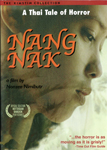
Nang Nak is an old Thai folk tale, and is set during the Thai-Vietnamese war of 1831-1834. A young citizen-soldier goes off to war
leaving behind his pregnant wife. The two of them are deeply in love. He suffers serious battle wounds and has to convalesce in a
hospital for many months. When he finally returns home, his pretty young wife greets him warmly with their infant son, and it is
only gradually that he learns that something is amiss – he doesn’t see the ghost, even though the neighbors have seen it for a long
time. In the end, the kingdom’s most famous Buddhist monk, Somdej Toh, arrives to exorcise the ghost using powerful magic. Somdej
Toh was a real historical monk. His images and statues are among the most revered icons in Bangkok today, and his magical amulets
are widely sought-after.
Nang Nak was produced in 1996 and set box-office records in Thailand when it was first released. This is
our Halloween offering for 2016. Admission is free.
The Science of Mindfulness: A Research-Based Path to Well-Being is a 24-lecture series on centered on research findings surrounding mindfulness and meditation. This screening is going to present modules 11 through 13 in the series:
(11) Connecting with Children and Adolescents
(12) Seeing Sadness and Depression in a New Light
(13) Befriending Fear, Worry and Anxiety
Each of these lectures will be followed by a brief discussion period.
Dr. Ronald D. Siegel is an Assistant Clinical Professor of Psychotherapy at the Harvard Medical School and an Adjunct Clinical
Professor of Psychiatry at the University of Massachusetts Medical School. He is the author or editor of a number of important
publications, including: The Mindfulness Solution: Everyday Practices for Everyday Problems. These films are being screened
courtesy of The Teaching Company, http://www.thegreatcourses.com.
Admission is free.
Stalin’s collectivization of ethnic Mongolian farmers and herders during the 1920s and 1930s forced many of them to flee from Russia into Mongolia. The border between
Russia and Mongolia is long and heavily forested and leaks like a sieve, and the Mongolians are a nomadic people, so movement is easy for them. Unable to stop the
border crossings, the Soviets demanded help from their Mongolian allies to deal with anyone who did not comply with their demands. During the 1930s there were many
trials in the “Great Purge”, including six trials of Mongolian Buddhist clergy, many of them accused of the crime of “raising the prestige of religion.” An estimated
18,000 Buddhist clergy were executed, along with countless thousands of other Mongolian citizens. A Pearl in the Forest tells the story of a small Mongolian village
caught up in Stalin’s collectivizations. One of the local boys has joined the Communist Party and is directly involved in jailing and murdering his former neighbors
and members of his own family. There is a love story woven into the fabric of the tale, and the “Pearl in the Forest” is a baby born in the wilderness. But where is
the Buddhism in this film? There is a village idiot dressed in rags, always smiling and friendly with everybody – even when smiling is inappropriate – who can be seen
playing with the village children – not unlike Ryokan. A Pearl in the Forest is a powerful film with a surprise ending. Spoken in Mongolian with English subtitles, it
is being screened courtesy of Idugan Entertainment, www.idugan.com. 90 Minutes.
Admission is free.
The Science of Mindfulness: A Research-Based Path to Well-Being is a 24-lecture series on centered on research findings surrounding mindfulness and meditation. This screening is going to present modules 8 through 10 in the series:
(8) Tailoring Practices to Fit Changing Needs
(9) Modifying Our Brain Function and Structure
(10) Solitude - An Antidote to Loneliness
Each of these lectures will be followed by a brief discussion period.
Dr. Ronald D. Siegel is an Assistant Clinical Professor of Psychotherapy at the Harvard Medical School and an Adjunct Clinical Professor of Psychiatry at the University of Massachusetts Medical School. He is the author or editor of a number of important publications, including: The Mindfulness Solution: Everyday Practices for Everyday Problems. These films are being screened courtesy of The Teaching Company, http://www.thegreatcourses.com.
Admission is free.
Dilgo Kyentse Rinpoche (1910-1991) was a revered Tibetan Lama. He spent many years enduring austerities, including prolonged meditation retreats in
caves in the Himalayas. His life story is chronicled in the film Brilliant Moon. Being worshipped by crowds of adult followers seems natural enough
for an elderly teacher. However, it is a bit jarring to see many of these same followers worshipping his four-year old reincarnation. Jigme Lhundrup
is Yangsi, a tulku – a reincarnated holy man – and is the son of Tsikey Chokling Rinpoche, one of the founders of the Kya-Nying Shedrub Ling monastery
in Katmandu, Nepal. How he came to be recognized as a reincarnation of Dilgo Kyentse Rinpoche is explored in detail in Yangsi. Yangsi is a
sensitively drawn portrait and follows the life of Jigme Lhundrup from early childhood until he reaches his late teens. By the end of the film, he
is now a teenager, and a girl his own age in the audience asks him: “When you were a boy, what did you want to be when you grew up?” Needless to
say, he didn’t really have much choice in the matter. Yangsi is being licensed through Kino Lorber, www.kinolorber.com. 81 minutes.
Kumaré is the story of documentary film maker Vikram Ghandi, an American of Indian descent. Growing up in New Jersey, he is
taken aback and disgusted by the blind faith which some Americans place in Indian gurus. A film maker by profession, with no prior religious vocation,
he assumes a phony Indian accent, dons the orange robes of a sadhu, and with the help of a pair of female accomplices, moves to Phoenix, Arizona, where
he sets himself up as a Guru. Without too much difficulty, in a short while, he acquires a sizable following insisting all the while that his followers
are all their own gurus. His followers are mostly naïve, sincere, spiritually-minded people. Kumaré is a provocative social-experiment/documentary.
Eventually he must reveal the hoax. 84 minutes. Admission is free.
The Science of Mindfulness: A Research-Based Path to Well-Being is a 24-lecture series on centered on research findings surrounding mindfulness and meditation. This screening is going to present modules 5 through 7 in the series:
(5) Mindfulness or Psychotherapy
(6) Attention and Empathy in Relationships
(7) The Science of Compassion and Self-Compassion
Each of these lectures will be followed by a brief discussion period – warranted by the intensity and complexity of the lectures.
Dr. Ronald D. Siegel is an Assistant Clinical Professor of Psychotherapy at the Harvard Medical School and an Adjunct Clinical Professor of Psychiatry at the University of Massachusetts Medical School. He is the author or editor of a number of important publications, including: The Mindfulness Solution: Everyday Practices for Everyday Problems. These films are being screened courtesy of The Teaching Company, http://www.thegreatcourses.com.
Admission is free.
Lost Treasures of Afghanistan details the looting and destruction of Buddhist art treasures by the Taliban, including
the giant Buddha statues at Bamiyan. Fanatical members of the Taliban believe that all images are sacrilegious, and
go about destroying them with sledge hammers, fire or dynamite. This is a film about courageous Afghans determined to
preserve their cultural heritage. Included also is a simulated re-enactment of the visit to Bamiyan and its
monumental Buddha statues by the Buddhist pilgrim Xuanzang 1,400 years ago. 56 minutes.
Angkor for Sale discusses the wholesale looting of Cambodia’s artistic heritage – a
profitable enterprise carried out with direct participation of the Cambodian army. Angkor Wat is one of the world’s
largest and most magnificent archeological sites, but the cultural heritage of the ancient Khmer empire has been
the target of art theft on a massive scale. One statue stolen from a local Cambodian museum ended up in the
Metropolitan Museum of Art. This film was screened on location in Cambodia and Bangkok Thailand, where many of
the Cambodian antiquities are removed for sale. 53 minutes. Admission is free.
Why do poor people often seem happier than rich people? Must a society lose its traditions in order to move into the future? How do you reconcile a commitment to non-violence when faced with violence? Will
there be another Dalai Lama? These are some of the questions Rick Ray poses to the Dalai Lama – he actually poses more than 10 questions. With the insertion of background material and video clips during the
actual interview process, the film is quite engrossing. It also touches on some fairly loaded political material, such as the fate of the Panchen Lama. The Dalai Lama comes across as very much an ordinary
human being of great wisdom and great spirit. 85 minutes. This film is being licensed through Swank Motion Pictures, http://www.swank.com. Admission is free.
The Science of Mindfulness: A Research-Based Path to Well-Being is a 24-lecture series on centered on research findings surrounding mindfulness and meditation. This screening is going to present modules 1 through 4 in the series:
(1) Why Mindfulness Matters
(2) Our Troublesome Brains
(3) Informal, Formal and Intensive Practices
(4) Who Am I? The Perils of Self
Dr. Ronald D. Siegel is an Assistant Clinical Professor of Psychotherapy at the Harvard Medical School and an Adjunct Clinical Professor of Psychiatry at the University of Massachusetts Medical School. He is the author or editor of a number of important publications, including: The Mindfulness Solution: Everyday Practices for Everyday Problems. These films are being screened courtesy of The Teaching Company, http://www.thegreatcourses.com.
Admission is free.
The Long Search is a BBC classic first screened in the 1970s, and includes modules dealing with Christianity, Judaism, Islam, Buddhism, Hinduism and African and Indonesian animist faiths.
Volume 3: Buddhism: Footprint of the Buddha - India takes us to Sri Lanka to explore the Theravadin Buddhism of southeast Asia. We meet with Buddhist monks, including one American,
schoolchildren, novices and housewives. Each offers something of his own experience to help us understand a religion that has high moral principles but does not believe in God. 54 minutes.
Volume 9: Buddhism: Land of the Disappearing Buddha – Japan takes us on a tour of a much more secular Mahayana Buddhist country. Would the Buddha of Japan and the Buddha of India
recognize one another if they were to meet? We are taken to a Japanese restaurant where the staff members practice regular Zen meditation. We are introduced to pure-land Buddhism, and are given a rare
opportunity to see a sanzen encounter between a Zen monk and Mumon Yamada, the abbot of Myoshin-ji. 54 minutes. Admission is free.
Deep within the wind-swept marshes of war-torn medieval Japan, an impoverished mother and her daughter-in-law eke out a lonely, desperate existence. They murder lost samurai and sell their belongings for grain.
They dump the corpses down a deep, dark hole and live off of their meager spoils. When a bedraggled neighbor returns from the war, lust, jealousy, and rage threaten to destroy the trio's tenuous existence,
before an ominous, ill-gotten demon mask seals their horrifying fate. Driven by primal emotions, dark eroticism, a frenzied score by Hikaru Hayashi, and stunning images both lyrical and macabre, Kaneto Shindo’s
chilling folktale, Onibaba, is a singular cinematic experience.
Onibaba derives its demon-mask sequence from an old Buddhist folk tale involving a mother and her daughter-in-law. The daughter-in-law is very pious and frequently goes to temple to pray to the Buddha.
Her mother-in-law despises this and waits for her on a path at night. She jumps out in front of her daughter-in-law while wearing a Noh demon mask and frightens her to death. Then, the mother-in-law finds it
impossible to remove the demon mask, which is now stuck to her face. After unsuccessfully trying to remove it, she prays to the Buddha to allow her to remove the mask. Eventually, she is able to pull the mask
off of her face, but it removes the skin of her face along with it. Onibaba means “female demon.” Onibaba is our Halloween offering this year.
Admission is free.
Friday September 4, 2014 7:30 - 9:30 PM.
Great Minds of the Eastern Intellectual Tradition:
Great Minds of the Eastern Intellectual Tradition is a 36-lecture series on Eastern Philosophy taught by Professor Grant Hardy. This screening is going to present modules 33 through 36 and
will conclude the series.
Kang Youwei and Hu Shi
Sun Yat-sen and Mao Zedong
Modern Legacies
East and West
Dr. Grant Hardy is Professor of History and Religious Studies at the University of North Carolina at Asheville. He earned his B.A. in Ancient Greek from Brigham Young University and his Ph.D. in Chinese Language and Literature
from Yale University. Professor Hardy has written, co-written, or edited six books, including Worlds of Bronze and Bamboo: Sima Qian's Conquest of History and
The Establishment of the Han Empire and Imperial China. These films are being screened courtesy of The Great Courses. Admission is free.
The Dhamma Brothers: “This provocative film follows a small group of inmates through a strict course of Vipassana meditation. For nine days participants
must abstain from talking (as well as from killing, stealing and intoxicants) and follow a regimented schedule of meals, rest and noble silence. According to the convicted
murderer Grady Bankhead, those nine days were tougher than his eight years on Death Row. Directed by Jenny Phillips (an anthropologist and psychotherapist who initiated the
program), Andrew Kukura and Anne Marie Stein, The Dhamma Brothers offers a constructive alternative to the hopelessness of human warehousing. Opening up her film to include
prison staff (cautiously impressed with the students behavioral changes), inmates families and members of the public, Ms. Phillips candidly documents the mixed emotions and
institutional conflicts aroused by the introduction of a Buddhist practice in a predominantly Christian prison. Vipassana means to see things as they are, says Bruce Stewart,
one of the program s two teachers. For men like Mr. Bankhead, that may be the only freedom they will ever know.” --The New York Times. Approx. 120 Minutes. Admission is free.
Xian Chang’an, The Cradle of Chinese Civilization: depicts the ancient Chinese capital of Xi’an, lying at the eastern end of the silk road.
In previous centuries it was the entry point for Buddhist, Christian and Islamic missionaries traveling to China. This video shows us the army of terracotta warriors just
to the north of Xi’an, and the “Forest of Stele” – a huge array of stones on which were carved imperial edicts, Buddhist sutras and other documents. The stones were inked
to make multiple copies on paper. The film includes Buddhist temple rituals and a performance from T’ang dynasty theater, as well as visits to Han and T’ang dynasty imperial
tombs. Screened courtesy of Kultur Videos, 56 minutes.
Hue, City on the Perfume River: depicts the ancient Vietnamese capital of Hue. Modeled on China’s Forbidden City, the city of Hue was the imperial
capital and cultural heart of Vietnam. The video focuses on the tombs, Buddhist temples, the citadel of Hue, and of course, on the Song Huan river, the “Perfume River” so
called because of the fragrant pollen which it carries at certain times of year. Screened courtesy of Kultur Videos, 57 Minutes.
Friday June 12, 2014 7:30 - 9:30 PM.
Great Minds of the Eastern Intellectual Tradition:
Great Minds of the Eastern Intellectual Tradition is a 36-lecture series on Eastern Philosophy taught by Professor Grant Hardy. This screening is going to present modules 29 through 32 in the series:
Great Minds of the Eastern Intellectual Tradition.
Science and Technology in Pre-Modern Asia
Mohammad Iqbal and Rabindranath Tagore
Mohandas Gandhi – Satyagraha or Soul-Force
Fukuzawa Yukichi and Han Yongun
Dr. Grant Hardy is Professor of History and Religious Studies at the University of North Carolina at Asheville. He earned his B.A. in Ancient Greek from Brigham Young University and his Ph.D. in Chinese Language and Literature
from Yale University. Professor Hardy has written, co-written, or edited six books, including Worlds of Bronze and Bamboo: Sima Qian's Conquest of History and
The Establishment of the Han Empire and Imperial China. These films are being screened courtesy of The Great Courses.
The Zen Gardens at Kinkakuji, a UNESCO World Heritage Site: The site of Kinkaku-ji was originally a villa, and was purchased by Shogun Ashikaga Yoshimitsu. When Yoshimitsu
died, the building was converted into a Zen temple by his son, according to his wishes, the “Temple of the Golden Pavilion.” The Temple and gardens constitute the
Kinkaku-ji complex, a superb Muromachi period Zen garden. This film is being screened courtesy of The Institute For Zen Studies, 20 minutes.
Secrets of the Dead - Bones of the Buddha: Did nineteenth century British landowner W.C. Peppé really discover gold, jewels and the charred bones of the Buddha on his estate in Uttar Pradesh?
The British landowner, who fancied himself an archeologist, did an exploration of a mysterious mound which he found on his estate. His amateurish approach and involvement of a crooked
German archeologist discredited the entire excavation of the Piprahwa stupa. Buried in the mound were 1600 small jewels and pieces of gold, and a reliquary containing ashes and fragments of
human bone purportedly interred by the Indian Emperor Ashoka. More recently, the Piprahwa stupa was re-investigated by a professional team, and further digging revealed an additional layer of
objects most likely dating back to the time of the Buddha. Secrets of the Dead - Bones of the Buddha is being licensed
through NOVA/Public Broadcasting Corporation. 60 Minutes.
Prem Sanyas (The Light of Asia) (Die Leuchte Asiens in German) is a 1925 silent film, directed by Franz Osten and
Himansu Rai. It was adapted from Sir Edwin Arnold’s epic poem, The Light of Asia (1879), based on the life of Prince Siddhartha Gautama. The
film was an Indo-European co-production, released during the time of the Weimar Republic, with German technicians and Indian actors. It was
made with the cooperation of the Maharajah of Jaipur and included a cast of thousands. Shooting took place in Lahore, in what is now Pakistan,
where the set decoration was created by Devika Rani, the wife of actor/director Himanshu Rai. The film was released in the USA by the Film Arts
Guild on 11 May 1928. The Light of Asia depicts the story of Prince Siddhartha Gautama (portrayed by director Himansu Rai), the man who became
the Buddha, as he journeys from privilege and seclusion to awareness of the inevitability of life's suffering, finally renouncing his kingdom to
seek enlightenment. The film features the competitive tests of manhood which Siddhartha must undergo in order to win his wife, and depicts the
machinations of Siddhartha’s evil cousin Devadatta. In what is definitely a piece of poetic license, Gopa, the Buddha’s wife, instead of staying
at home in the palace after his departure, goes after him into the forest and becomes his first disciple! This film is being screened courtesy of
Rare Film Classics. 97 Minutes.
Admission is free.
The Zen Gardens at Tofukuji: Tofukuji is a large temple complex located at the foot of the East Mountains in Kyoto, and home to some of Japan’s greatest Buddhist architecture.
Crossing the Bridge to Heaven over the Sengyoku Ravine, the visitor enters the dry landscape garden in the precincts of the Founder’s Hall.
For centuries this has been a place of Zen practice. This beautiful DVD shows the garden at all seasons of the year. The Zen Gardens at Tofukuji
is being screened courtesy of The Institute For Zen Studies, 20 minutes.
Zen and War: In the beginning of the 20th century Japan waged a number of wars during which it committed atrocities
throughout Asia and the Pacific. In 1998 Brian Victoria's book "Zen At War" documented the participation of Buddhist monks in these hostilities.
In Zen and War, Japanese Zen monks question their predecessors' wartime collaboration for the first time. A Dutch woman, Ina Buitendijk, whose
husband suffered duration his internment in a Japanese camp, took the initiative to ask Zen institutions how monks could have become involved
in wartime violence. Contemporary Zen masters, seeing the continuing suffering, responded to her inquiries. Zen and War is being screened
courtesy of the Buddhist Broadcasting Foundation, 60 Minutes.
The Dalai Lama Looks Back is a 1984 interview of the Dalai Lama by William F. Buckley. The present Dalai Lama assumed the position of supreme
spiritual leader of Tibet in 1950, the same year that Mao’s army invaded Tibet. In 1959, he fled to India, after, as Mr. Buckley relates, “an uprising against the Chinese Communists which
would result, in the ensuing decades, in a holocaust that would rank with Hitler’s and Pol Pot’s: 1.2 million Tibetans killed, one-seventh of the population.” As the Dalai Lama puts it:
“if there is a clear-cut dialogue between Buddhists and Marxists, it may help the Marxists and they may eventually become more human – less rigid – for the Buddhists have the message of love and
compassion… The Dalai Lama Looks Back is being licensed through the Hoover Institution (www.hooverpress.org). 60 minutes.
Tibet - The Truth presents a Chinese Communist perspective on the relationship between Tibet and China. In the words of Monarex: “Tibet’s geo-political history is
fairly clear up to the 19th and 20th centuries. It was during this period that Western Imperialism began to muddy the waters and campaigns were launched to create an insecure western border
for China. Additional influences include rampant civil unrest within China, the forming of the Republic of China after the fall of the Qing Dynasty in 1911, Japanese aggression that tormented
the people of China for many years, and finally, the involvement of the United States (namely the CIA) in using the 14th Dalai Lama as a poster-child and ally in its Anti-Communist agenda during
the Cold War. Before 1959, the year the People’s Liberation of China quelled the Upper-Class Tibetan Revolt, the vast majority of Tibetans were subjected to slavery and serfdom, a major issue
that is chronically ignored in any popular assessment of Chinese-Tibetan history.” Tibet – The Truth is being screened courtesy of Monarex Hollywood (www.Monarex.com). 60 minutes.
Admission is free.
Friday January 9, 2014 7:30 - 9:30 PM.
Great Minds of the Eastern Intellectual Tradition:
Great Minds of the Eastern Intellectual Tradition is a 36-lecture series on Eastern Philosophy taught by Professor Grant Hardy. This screening is going to present modules 25 through 28 in the series:
Great Minds of the Eastern Intellectual Tradition.
Dogen and Hakuin – Zen Buddhism
Zeami and Sen no Rikyu – Japanese Aesthetics
Wonhyo to King Sejong – Korean Philosophy
Padmasambhava to Tsongkhapa – Tibetan Ideas
Dr. Grant Hardy is Professor of History and Religious Studies at the University of North Carolina at Asheville. He earned his B.A. in Ancient Greek from Brigham Young University and his Ph.D. in Chinese Language and Literature
from Yale University. Professor Hardy has written, co-written, or edited six books, including Worlds of Bronze and Bamboo: Sima Qian's Conquest of History and
The Establishment of the Han Empire and Imperial China. These films are being screened courtesy of The Great Courses.
A History of Zen Buddhism, Part II: Rise and Fall traces Zen’s golden age in Japan through its steep rise and tremendous growth through its period of aesthetic
excess and spiritual decadence to a period of great destruction and eventual renewal. Here the lives of some of Japan’s most important masters such as Daito Kokushi, Ikkyu Sojun and Hakuin
Ekaku, as well as the Zen poet Ryokan are examined in detail. In addition, there are segments examining the role of the tea ceremony in Zen and a look at the evolution and function of Zen art
and calligraphy. 68 Minutes. Part III: Zen Comes West discusses the current state of Zen in Japan and the dissemination of Zen to the West. It also shows how Zen’s
core values are being revitalized in its journey to the West and contains an examination of the fundamental role of meditation in the practice of Zen Buddhism. 30 minutes. A History of
Zen Buddhism, Parts II and III, is being screened courtesy of James Zito and Vajra Video.
Admission is free.
A History of Zen Buddhism, Part I: Zen Beginnings is a documentary about the early history of Zen Buddhism. It covers Zen in China and the early introduction of Zen
into Japan. It also places Zen within the larger historical context of Buddhism in general. It profiles the important Zen masters Eisai, Dogen and Muso Soseki, and examines the etiology and
aesthetic of the Zen Garden. Parts II and III will be screened in December at the First Zen Institute of America. 60 minutes. The Zen Garden at Ginkakuji. Ginkakuji was founded by the shogun
Ashikaga Yoshimasa following his retirement to Kyoto’s East Mountains for a life of peaceful seclusion. The Ginkakuji garden is a typical stroll around garden, designed for appreciation from
wherever one is on the path that surrounds the central Kinkyo-chi pond. The garden includes a distinctive expanse known as the “Sea of Silver” and a large, flat topped sand cone known as the
“Moon-Viewing Platform”. This beautiful DVD shows shots of the garden at all seasons of the year. 20 minutes. A History of Zen Buddhism, Part I: Zen Beginnings, is being screened courtesy of
James Zito and Vajra Video. The Zen Garden at Ginkakuji is being screened courtesy of The Institute for Zen Studies.
Admission is free.
Friday October 17, 2014 7:30 - 9:00 PM.
A Month of Hungry Ghosts - When They All Return (95 Minutes), Copyright (c) 2009 Mythopolis Pictures. This film is being screened courtesy of Mythopolis Pictures (http://Mythopolis.com), and is available for purchase directly on their website or through Amazon.com
A Month of Hungry Ghosts - When They All Return is a documentary about the annual "Hungry Ghost Festival" in Singapore. During the seventh lunar month the gates of hell open up and all
souls are free to wander the earth and revisit their former habitations in ghostly form.. It is the occasion for many religious and folk festivals. The Buddhists invite the dead by candlelight, Taoists perform
rituals to appease the spirits, and there is much superstition in business, financial markets and personal lives. If you want grandfather to enjoy himself in the afterlife, then burn "hell currency" money, paper
cars, houses and computers so that he can take them with him to the next world. Thousand year old Buddhist scrolls help to explain the origins of ghost month. This film is decked out with vibrant images and is
at times playful and at times eerie. Traditional Chinese instruments and folk songs provide a colorful soundtrack. This film is our Halloween offering this year, and is being provided courtesy of Mythopolis
Pictures, http://mythopolis.com/. Admission is free.
Friday September 5, 2014 7:30 - 9:30 PM.
Great Minds of the Eastern Intellectual Tradition:
Great Minds of the Eastern Intellectual Tradition is a 36-lecture series on Eastern Philosophy taught by Professor Grant Hardy. This screening is going to present modules 21 through 24 in the series:
Great Minds of the Eastern Intellectual Tradition.
Al-Biruni - Islam in India
Nanak and Sirhindi - Sikhism and Sufism
Han Yu to Zhu Xi - Neo-Confucianism
Wang Yangming - The Study of Heart-Mind
Dr. Grant Hardy is Professor of History and Religious Studies at the University of North Carolina at Asheville. He earned his B.A. in Ancient Greek from Brigham Young University and his Ph.D. in Chinese Language and Literature
from Yale University. Professor Hardy has written, co-written, or edited six books, including Worlds of Bronze and Bamboo: Sima Qian's Conquest of History and
The Establishment of the Han Empire and Imperial China. These films are being screened courtesy of The Great Courses.
Friday August 08, 2014 7:30 PM.
Marco Polo's Roof of the World (90 Minutes), Copyright (c) 2007 Monarex Hollywood. This film is being screened courtesy of Monarex Hollywood (www.monarex.com).
Marco Polo's Roof of the World is a documentary dealing with life around Qinghai lake in eastern Tibet. This is a watershed region, the source of many rivers, and home to several exotic
species of birds. As a holy place for Tibetan Buddhists, it is not uncommon to see Tibetan pilgrims circumambulating Qinghai Lake. The film follows a group of pilgrims as they make progress on their journey around the lake. One
full prostration, three steps forward, another full prostration, another three steps forward, and so forth around the full 200 mile circumference of the lake - similar to the practice of circumambulating Mt. Kailash in western Tibet.
The film also takes us inside a Tibetan convent and finishes off with Bon tradition Shamans. The Shamans are highly unusual. They perform blood rituals and go into trance states resembling the trance states of the Tibetan Oracle.
Some of the magic and rituals found in Tibetan Buddhism appear to have been borrowed from the Bon tradition. This is a beautifully shot film with expert cinematography. It has little to do with Marco Polo apart from the fact that
the Venetian explorer traveled through this part of China and recorded his experiences in his book, "The Travels of Marco Polo." Admission is free.
Friday July 11, 2014 7:30 - 9:30 PM.
Great Minds of the Eastern Intellectual Tradition:
Great Minds of the Eastern Intellectual Tradition is a 36-lecture series on Eastern Philosophy taught by Professor Grant Hardy. This screening is going to present modules 17 through 20 in the series:
Great Minds of the Eastern Intellectual Tradition.
Xuanzang and Chinese Buddhism
Prince Shotoku, Lady Murasaki, Sei Shonagon
Saicho to Nichiren—Japanese Buddhism
Shankara, Ramanuja, Madhva—Hindu Vedanta
Dr. Grant Hardy is Professor of History and Religious Studies at the University of North Carolina at Asheville. He earned his B.A. in Ancient Greek from Brigham Young University and his Ph.D. in Chinese Language and Literature
from Yale University. Professor Hardy has written, co-written, or edited six books, including Worlds of Bronze and Bamboo: Sima Qian's Conquest of History and
The Establishment of the Han Empire and Imperial China. These films are being screened courtesy of The Great Courses.
Japanese immigrants first came to Hawai'i in 1868 to work on American sugar plantations. They constructed nearly 300 Buddhist temples throughout the Hawaiian Islands, representing many different sects, including
Jodo Shin-shu, Shingon, Nichiren, Higashi Hongwanji and Soto Zen. In some cases, they built Indian style temples, filled them with Christian church pews and sang modified hymns which praise the Buddha instead of Jesus.
Today the Buddhism which they created is fading, its temples are closing down and its aging congregations are dying off. Aloha Buddha documents the history of Japanese immigrants in Hawai'i and the modified form of
Buddhism which they created in their new home. Lorraine Minatoishi-Palumbo wrote her Ph.D. dissertation on the Japanese Buddhist temples of Hawai'i. For many years, Buddhism was the majority religion in Hawai'i,
but the Hawaiian Japanese community suffered large dislocations during World War II, and this contributed to a long decline in Hawaiian Buddhism. While Buddhism was and still is central to the life of the Japanese
communities in Hawaii, it is going through a prolonged transformation. This documentary includes restored archival film material and was funded in part by a grant from the Hawaii Council for the Humanities.
Admission is free.
The tsunami of 2011 and its aftermath, including the lethal radioactivity released by the Fukushima nuclear reactor, created a massive humanitarian crisis in Japan. Prior to the time the tsunami hit, Tim Graf from the
Institut Für Religions-Wissenschaft of the University of Heidelberg and Jakob Montrasio, an experienced cinematographer, traveled to Japan to film a documentary in support of Graf's research into Zen Buddhism. They had started
working on their film just before the tsunami struck. The resulting documentary provides a unique window into the practice of Zen Buddhism and the way in which Zen priests and monks handled the crisis. They opened up their
temples to support homeless survivors, played a pivotal role in mourning the dead and caring for the bereaved, and helped to rebuild shattered communities. Souls of Zen provides shocking and disturbing images of the tsunami and
its aftermath, and gives direct insights into Zen Buddhist beliefs and practices regarding death and dying. Spoken in English and Japanese with English subtitles. 93 Minutes. Admission is free.
They Call It Myanmar is a documentary about modern-day Myanmar, a.k.a. Burma. It picks up in documentary format where The Lady (the film screened last month at the First Zen Institute) leaves off.
They Call It Myanmar culls the best footage from over 120 hours of striking images. It features interviews and interactions with more than 100 people throughout Burma, and these ordinary citizens are the stars of the show.
The film showcases real humor, hope and warmth coming from people who have lived for decades under a repressive military dictatorship. There are numerous shots of temples, monks and ordinary laborers. The film provides real
insight into a beautiful and troubled country. The director was finishing off his production in 2010 when he learned of Aung San Suu Kyi's release from house arrest, and arranged an interview with her. The film is not about
Aung San Suu Kyi, but her interview is weaved into an overall tapestry about Burma, and she shares some candid insights and wisdom. The film was shot at a turning point in Burma's history, as the nation has opened up
considerably since 2010. Aung San Suu Kyi was elected to Burma's parliament in 2012 and plans to run for the presidency in 2015. The footage shown here was - at the time - shot clandestinely, before Burma had deposed
its military dictators and opened up to the outside world. 83 Minutes. Admission is free.
The Lady is a dramatization of the life story of Aung San Suu Kyi, the Burmese democracy leader and Nobel Peace Prize Laureate. The story starts with the murder of her father, a Burmese national hero who freed Burma
from both British and Japanese rule. Forty years later, she is a British housewife with two young sons. The story is told both from her perspective and that of her husband, an Oxford professor who is slowly dying of
cancer. Her pleasant life in Britain comes to an end when she visits Burma on the occasion of her mother's death, and becomes the de-facto leader of the protest movement against the military regime. She faces down
hordes of gun-toting soldiers like the Buddha facing down a rampaging elephant. Her imprisonment at the hands of the Burmese military dictatorship lasts for years, and only comes to an end when a small army of
Buddhist monks demand her release. Michelle Yeoh puts in a strong performance, reproducing Aung San Suu Kyi's mannerisms and stern but compassionate facial expressions. Michelle Yeoh learned Burmese so that she
could deliver some of Aung San Suu Kyi's most famous speeches. Her inspirational performance is mirrored by that of David Thewlis, who plays Aung San Suu Kyi's husband, Michael Aris. 128 Minutes. Admission is free.
In 2006, the Kingdom of Nepal became the Republic of Nepal, and the Shah family, which had ruled Nepal for 240 years, was deposed. Most of the world's media attention at that time was focused on the wars in
Iraq and Afghanistan, so Nepal received little attention. The April Uprising in 2006 involved over one million people, the largest civil protest movement Nepal had ever experienced. The People's Nepal is the story of a
revolution and its causes. For centuries, Nepal has been part Hindu and part Buddhist. As is well known, the Buddha was openly and explicitly anti-caste, and not just once or twice, but in many sutras.
This film shows the leader of the youth group from the Maoist party quoting directly from the Buddha to justify the party's actions. The Maoists were one of several political parties involved in the struggle
to bring representative government to Nepal. The film includes original music, archival photography, and a voice-over narrative by Peter Coyote. 77 Minutes. Admission is free.
Friday January 10, 2014 7:30 PM.
Great Minds of the Eastern Intellectual Tradition:
Great Minds of the Eastern Intellectual Tradition is a 36-lecture series on Eastern Philosophy taught by Professor Grant Hardy. This screening is going to present modules thirteen through sixteen in the series:
Great Minds of the Eastern Intellectual Tradition.
Ishvarakrishna and Patanjali - Yoga
Nagarjuna and Vasubandhu - Buddhist Theories
Sima Qian and Ban Zhao - History and Women
Dong Zhongshu and Ge Hong - Eclecticism
Dr. Grant Hardy is Professor of History and Religious Studies at the University of North Carolina at Asheville. He earned his B.A. in Ancient Greek from Brigham Young University and his Ph.D. in Chinese Language and Literature
from Yale University. Professor Hardy has written, co-written, or edited six books, including Worlds of Bronze and Bamboo: Sima Qian's Conquest of History and
The Establishment of the Han Empire and Imperial China. These films are being screened courtesy of The Great Courses.
Secrets of Shangri-La takes us into sacred Buddhist caves in the legendary kingdom of Mustang. A team of explorers and scientists climbs for the first time into human-carved caves thousands of years old. They
find priceless 14th century wall paintings, ancient human remains and a centuries-old library of sacred Buddhist texts. Conflicts with the local villagers arise when the villagers realize that they may have lost forever
an opportunity to loot the caves and sell the art at high prices on the international art market. Instead, it is destined to be preserved by the government of Nepal. 57 minutes.
Cave People of the Himalaya takes us on an expedition to ancient caves in upper Mustang, a part of Nepal so remote that there are not even any real roads up the valleys, and the expedition truck has to navigate along stream
beds. Several of these caves are located high in the middle of friable sandstone cliffs, and the climb is very risky, even with expert rock climbers leading the way. One of the climbers suffers serious injuries and has
to be evacuated by helicopter. However, the discoveries are intensely interesting to American archeologist Dr. Mark Aldenderfer. He may have located some of the earliest "sky-burials" in the Himalayas, either Buddhist
or pre-Buddhist in origin. 55 minutes.
Marco Polo's Silk Road
is a film about the tea road (otherwise known as the "southern silk road") which snakes through Yunnan Province into Tibet and India. This road has been traveled for over a thousand years,
and is still in use. This film starts with a discussion of tea growing and harvesting and then follows a caravan of pack horses laden with tea as it travels through Yunnan province into Tibet. Isn't China modernizing
with roads and railroads? In this particular setting because of the ruggedness of the mountains, the old silk road is still in use - with pack horses and cell-phone toting caravan leaders. Horses can go places where
automobiles and trucks cannot go - provided that the horses can negotiate steep mountain gorges crossed by rickety bridges and cable-pulley systems. Tea is a standard drink in Zen temples, and this film provides a
little bit of background on the historical transport of tea from India to China in ancient times, all driven by the profit motive and the abiding Chinese (and later Japanese) love of tea. Be forewarned: toward the
end, the film touches on the Chinese/Tibetan conflict, and casts it in a decidedly pro-Chinese light. 90 Minutes. Admission is free.
Noh Dojoji
is a Noh drama based on an old legend. A mountain yamabushi (a Buddhist ascetic) occasionally visited the home of a poor farmer and his daughter. The farmer jokingly told his daughter that someday the yamabushi would
become her husband. The girl innocently believed him, and when she came of age, asked the yamabushi to marry her. He turned her down, and when she became enraged, ran away from her, making his way to Dojoji temple.
There, the monks lowered the huge temple bell and hid the yamabushi underneath the bell. The girl, in hot pursuit, found her way blocked by the Hidaka river in flood, without a boat to cross. So intense was her rage
that she transformed into a river serpent of the fire-breathing variety, swam across the river, entered Dojoji temple and wrapped herself around the temple bell. She generated a heat so intense that the yamabushi roasted
to death inside the bell!
The play itself begins many years later, at the time of a dedication ceremony for a new temple bell. This is a full-length 109 minute Noh drama, with English-language commentary on the action. It features the famous
Noh actor Umewaka Rokuro, and is filmed at the Noh theatre at Nagoya Nohgakudo. Noh drama is poetry and music in slow-motion, and this should be borne in mind. Modern audiences acclimated to fast action may find the
slow pace not to their liking. Noh Dojoji is classical Noh drama at its best. Admission is free.
Friday September 6, 2013 7:30 PM.
Great Minds of the Eastern Intellectual Tradition:
Great Minds of the Eastern Intellectual Tradition is a 36-lecture series on Eastern Philosophy taught by Professor Grant Hardy. This screening is going to present modules nine through twelve in the series:
Great Minds of the Eastern Intellectual Tradition.
Mencius and Xunzi-Confucius's Successors
Sunzi and Han Feizi-Strategy and Legalism
Zarathustra and Mani-Dualistic Religion
Kautilya and Ashoka-Buddhism and Empire
Dr. Grant Hardy is Professor of History and Religious Studies at the University of North Carolina at Asheville. He earned his B.A. in Ancient Greek from Brigham Young University and his Ph.D. in Chinese Language and Literature
from Yale University. Professor Hardy has written, co-written, or edited six books, including Worlds of Bronze and Bamboo: Sima Qian's Conquest of History and
The Establishment of the Han Empire and Imperial China. These films are being screened courtesy of The Great Courses.
Journey Into Buddhism: Dharma River
is an exquisitely beautiful journey through Laos, Thailand and Burma, exploring the important themes and landscapes of Buddhism at the source. Moving down rivers, through villages, and to important Buddhist pilgrimage
sights...the visuals and narration create a mood of timeless peace. Dharma River is part of the Yatra trilogy of sacred journeys into Buddhism by director and cinematographer John Bush. Yatra is the Sanskrit word for pilgrimage or spiritual journey. This is a meditative
journey accompanied by music - classical Saung Gauk (Harp) of Burma; the Khene, the giant mouth organ of Laos, and the centuries old Pi Phat ensemble of Thailand which includes gongs, xylophones and cymbals,
and harmonic chants from singer and composer David Hykes with The Harmonic Choir. En route, the journey locales include the Emerald Buddha, the Royal Temple, the
Ananda Temple built in 1091, Chaing Mai, Karen people, Mekong River, Shangri-la of Luang Prabang, Swedagon Pagoda, mystical sites and ruins of ancient civilizations, and a myriad of iconic representations of
the Buddha himself. John Bush undertakes the production of a travel documentary as if it were fine art. This is as good as this genre gets.
Preaching From Pictures: A Japanese Mandala tells the story of the Kumano nuns, a Buddhist sect which traveled the Japanese countryside during the pre-modern era. They preached
from a hanging scroll called the Mandala of the Ten Worlds. The Mandala depicts the ten realms of existence, and traces the path which human beings must take from birth through youth, middle age, old age
and death. Heaven and hell are included in graphic format, along with buddhas, bodhisattvas, demons and devils. This film includes a 37 minute tour of the Mandala, a 4 minute sermon similar to what the
Kumano nuns might have delivered and a virtual hour long academic symposium on the Mandala and its historical context. Preaching From Pictures is based on a film produced by the National Museum of
Japanese History. The Freeman Foundation funded the production of this English-language DVD. This film is being screened at the First Zen Institute courtesy of the Asian Educational Media Service (www.aems.illinois.edu)
Doing Time, Doing Vipassana takes the viewer into Tihar prison, a huge and notorious institution housing 10,000 inmates. This is India's largest prison, and is now a place where men doing hard time for serious
crimes have started practicing meditation. They don't get a light dose of it, but a full ten day retreat conducted in total silence, with ten hours of meditation every day. The Vipassana meditational techniques
are taught by a Theravadin Buddhist teacher, S.N. Goenka in the Burmese tradition of Sayagyi U Ba Khin, but are quite similar to Zen. There is nothing easy about it, and no one expects fast miracle results, but
some of the inmates are deeply affected by it. Changing From Inside takes the same meditational techniques employed in Tihar prison and applies them in a modern American prison. Both films briefly mention the
historical Buddhist roots of this type of mediation, but the religious aspects of it are de-emphasized. These are expertly shot professional documentaries, and give real insights into the practical application of
classical Buddhist meditation techniques. These films are being screened courtesy of the Vipassana Research Institute (www.vridhamma.org) and Pariyatti Digital Media (www.pariyatti.org).
For more information about Vipassana Meditation As Taught By S.N. Goenka in the tradition of Sayagyi U Ba Khin, please visit the Vipassana Meditation website, www.dhamma.org.
The films themselves are directly available through the Vipassana Research Institute website, www.vridhamma.org.
Friday May 17, 2013 7:30 PM.
Great Minds of the Eastern Intellectual Tradition:
Great Minds of the Eastern Intellectual Tradition is a 36-lecture series on Eastern Philosophy taught by Professor Grant Hardy. This screening is going to present modules five through eight in the series:
The Bhagavad Gita-The Way of Action
Confucious-In Praise of Sage-Kings
Laozi and Daoism-The Way of Nature
The Hundred Schools of Pre-Imperial China
Dr. Grant Hardy is Professor of History and Religious Studies at the University of North Carolina at Asheville. He earned his B.A. in Ancient Greek from Brigham Young University and his Ph.D. in Chinese Language and Literature
from Yale University. Professor Hardy has written, co-written, or edited six books, including Worlds of Bronze and Bamboo: Sima Qian's Conquest of History and The Establishment of the Han Empire and Imperial China.
These films are being screened courtesy of The Great Courses.
Buddhist antiquities sometimes sell for hundreds of thousands or even millions of dollars on the international art market. Over the past century, it has happened not infrequently that art objects kept in not-very-secure places, such as remote
village temples, have just disappeared. Ong-Bak The Thai Warrior, starts in the village of Ban Nong Pradu, a rural village in northeastern Thailand, where the head from a local Buddha statue is lopped off and vanishes. The Buddha statue's name
is "Ong-Bak." However, the culprit is spotted by the villagers, and they send their best athelete - Ting, played by Tony Jaa - on a mission to Bangkok to retrieve the Buddha head. Ting has learned muay Thai (Thai kick-boxing) from one of the
village monks, and finds himself in Bangkok up against a crime gang which steals Buddhist antiquities on a professional basis. This is an action film dealing with loss and redemption of cultural heritage. Spoken in Thai with English subtitles.
The Sage of Arunachala is a chronology of photographs, film footage, interviews, narration and music - the culmination of two-year effort of film restoration, research and travel. Narrated by John Flynn with
professional editing by James Hartel, it takes the viewer back to the childhood home of Venkataraman Iyer in Tiruchuli, Tamil Nadu, and discusses his experience of Self Realization, his journey to Arunachaleswara temple, his taking the vows of a sadhu and assumption of a
life of austerity, his life in the caves on Arunachala hill, and his eventual prominence as perhaps the most widely respected Indian sage of the twentieth century. Bhagavan Sri Ramana Maharshi: The Archival Films: This is a
collection of ten short films taken mostly by disciples of Ramana Maharshi. Most are silent, in black and white or color. Included are two short Indian newsreels with narration. These films are being screened courtesy of Arunachala Ashrama (www.arunachala.org).
Friday February 15, 2013 7:30 PM. Originally scheduled for Friday, February 8, this film has been rescheduled to Friday, February 15 due to severe weather conditions.
Kundun is a motion picture masterpiece directed by 5-time Academy Award nominee Martin Scorsese. It chronicles the life of the 14th Dalai Lama from the moment of his recognition as the
reincarnation of the 13th Dalai Lama in 1937 up until his exile from Tibet. The film's tone of serenity and reverence is upheld through meticulous attention to details of costume and color, and the use of actual
Buddhist monks in scenes from the Dalai Lama's palace. When first released, the film caused an international uproar. The actor Kim Chan (who starred in A Zen Tale - shot on site at the First Zen Institute) plays
the role of a Chinese General in Kundun.
Great Minds of the Eastern Intellectual Tradition is a 36-lecture series on Eastern Philosophy. This screening is going to present the first four modules in the series:
Life's Great Questions-Asian Perspectives
The Vedas and Upanishads-The Beginning
Mahavira and Jainism-Extreme Non-Violence
The Buddha-The Middle Way
Dr. Grant Hardy is Professor of History and Religious Studies at the University of North Carolina at Asheville. He earned his B.A. in Ancient Greek from Brigham Young University and his Ph.D. in Chinese Language and Literature
from Yale University. Professor Hardy has written, co-written, or edited six books, including Worlds of Bronze and Bamboo: Sima Qian's Conquest of History and The Establishment of the Han Empire and Imperial China.
These films are being screened courtesy of The Teaching Company.
A Zen Life is a biographical documentary of Daisetz Teitaro Suzuki (1870-1966) – a man who bore great responsibility for bringing Zen Buddhism to the West during the early decades of the 20th century. This film features
still shots taken from various stages in D.T. Suzuki’s life, a lively voice-over commentary, rare footage of D.T. Suzuki himself and interviews with many people who knew D.T. Suzuki personally, including Mickey Stunkard, Frederick Frank,
Huston Smith and Gary Snyder. 77 minutes.
Cold Mountain is a documentary about the Chinese Zen eccentric T'ang dynasty poet Han Shan "Cold Mountain" who lived on the mountain from which he took his name. Han Shan spent his time wandering through the
mountains writing poems on trees. He would often show up at the kitchen door to the temple in Kuo-ch'ing, where his friend Shi-te worked as a cook. We have little more than a bare outline of the details of Han Shan's life. However, his eloquent
poetry still resonates with modern readers. Four modern Zen poets and writers provide much of the commentary for this documentary: Gary Snyder, Red Pine, Burton Watson and Jim Lenfestey. 28 minutes.
Kwaidan consists of four ghost stories adapted from the fiction of Greek-born Lafcadio Hearn (a.k.a. Yakumo Koizumi, 1850-1904), who based them on old Japanese folk tales. According to legend, Hoichi the Earless is a blind
minstrel with amazing gifts for the Japanese lute. He is particularly good at performing the Tale of the Heike, an epic describing the fall of Emperor Antoku, who is buried at Amidaji Temple - the very temple where Hoichi is living. His performances
are so wonderful that even the ghosts hearing them are moved to tears. The ghosts like his singing so much that they want to drag him away to the next world, but he is protected after his body is painted with the characters of the Prajnaparamita
sutra - all parts of his body, that is, except his ears. Three additional ghost stories comprise the remainder of Kwaidan. All four stories start out as normal tales, and it is only gradually, by degrees, that ghostly horrors come into play - an
ideal film for the Halloween season. Spoken in Japanese with English subtitles.
Zen Noir is a surreal film in which a Mike Hammer-type left-brain police detective, still mourning the loss of his wife, enters the intuitive world of Zen in an effort to investigate a mysterious
death. Zen Noir is part murder mystery, part comedy, part Buddhist philosophy and part love story. This unusual film stars Kim Chan in the role of the Zen master. Zen Noir starts out as an investigation of one specific death and gradually turns
into an investigation into the nature of death itself. It contains some adult content, and is for mature audiences. Running time: 71 minutes. Zen Noir is being screened courtesy of Magic Lamp Releasing/Zenmovie LLC.
A Zen Tale is a comedy based on the classic Zen story about a monk who requests shelter for the night at a Zen temple, and must undergo "dharma-combat" with a one-eyed novice. A Zen Tale,
was the master's degree project of then-Columbia Film student Magdalena Solé, and was filmed right here on site at the First Zen Institute. All three roles in this film are played by Kim Chan. .
Warriors of Heaven and Earth is set in the western deserts of China during the Tang Dynasty. The "Warriors" are a group of contract soldiers who guard caravans traversing the old silk road. One of them is the
target of the Chinese emperor's wrath because of his refusal to obey explicit orders to massacre civilians (owing to which he lost his commission as an officer in the imperial service, and is now guarding caravans). The emperor sends a Japanese
assassin to murder him, but the two of them join forces to defend the caravan - putting off their final duel until later. On this particular occasion, the caravan consists of a large group of Buddhist monks along with relics of the Buddha which
they are transporting from India to China. The relics of the Buddha have real power (somewhat like
the power of the Ark of the Covenant in Raiders of the Lost Ark). One of the local warlords wants to seize the relics because of their power. Most of the action takes place outside of the borders of the Tang empire - a place inhabited by bandits
and nomads where ordinary laws don't apply. Spoken in Chinese with English subtitles.
Beyond Rangoon features Patricia Arquette in the role of an American physician, Laura, who is traveling on vacation in Burma when she unexpectedly gets caught up in the 1988 uprising of Buddhist monks against
the military government. Based on real-life events, the film features a confrontation between Aung San Suu Kyi, (played by Adele Lutz) who bravely calls for freedom in the midst of the soldiers who have been sent to stop her. During the historical 1988 uprising,
the government ordered soldiers to open fire on unarmed demonstrators, killing thousands of them. In the film, Laura travels "Beyond Rangoon" to visit the Burmese countryside, ordinarily off-limits to tourists. As the rebellion is suppressed, she is directly exposed to the Burmese military
dictatorship at its worst, and her professional skills come into play as a life-saving physician.
Journey Into Buddhism: Vajra Sky Over Tibet. "When the Iron Bird flies, the dharma will go to the West, says a 1,500-year-old Tibetan Buddhist prophecy, one that seems to have been amply fulfilled in 1959, when Mao's
Communist forces overwhelmed Tibet, killed a million or so Tibetans, and forced the 14th Dalai Lama into his still-continuing Western exile. In the near half-century since, there has been a deliberate long-term undermining of Tibet's ancient
Buddhist culture crudely violent in the Great Helmsman's time, more subtle and insidious since. Deep physical and spiritual scars remain on this tiny, beleaguered nation. Longtime Buddhist filmmaker John Bush took a two-person crew into the
country without official permission, they avoided interviews for fear of reprisals and filmed, often surreptitiously, the great religious sites as they exist now, after decades of oppression from Beijing. He finds a resilient, welcoming people
who continue to practice their religion (now officially tolerated ) despite the infiltration of Chinese agents into their monasteries, the razing of many sites to facilitate surveillance, and the kidnapping of the family of the 9-year-old
Pandau Lama (whose future duty is to choose the next Dalai Lama) and his replacement by a 6-year-old Beijing-backed stooge. Filmed only with direct light and sound, Bush's stunning camerawork adroitly captures the majestic landscapes and icons
of Buddhism: its murals and artworks, monks and nuns. Not incidentally, the film also offers a compact primer in the ways of dharma. A tonic for Buddhists, no doubt, it offers many pleasures to atheists as well." --John Patterson, Village Voice.
Kingdom of War, Part II continues the life story of Naresuan the Great, the Thai King of Ayutthaya from 1590 until 1605. In Part II, Naresuan is no longer a young Buddhist novice,
but a mature man capable of leading an army. Naresuan is played by Wanchana Sawatdee, a cavalry officer in the Royal Thai Army with the rank of captain. In this film -- set several years after Part I -- the powerful Burmese king has died,
and is succeeded by his incompetant son, leading to the gradual crumbling and fragmentation of his empire. The captive Thais living in the Burmese capital rally under Naresuan, and leave -- with the Burmese army in pursuit. The Thais hastily
assemble a group of their own fighters to fend off the Burmese. The wise Buddhist monk who played a prominent role in Part I of this series, also appears in
this film, along with Naresuan's close friends, now grown up. This film features the same beautiful costumes, impressive sets and expert camera-work found in Part I, and the the two films work well together to tell a complete story. Spoken
in Thai with English subtitles.
Kingdom of War, Part I is a dramatic re-telling, on a grand-scale, of the story of Naresuan the Great, the Thai King of Ayutthaya from 1590 until 1605. In 1563, the Burmese king of Hanthawaddy (lower Burma) led a massive army
against the Thais, defeating Naresuan’s father, King Maha Thammarachathirat. Taken hostage as a young boy, Naresuan was forced to live at the Burmese capital, where he became a Buddhist novice, and was tutored in everything – including the arts of war –
by a wise Buddhist monk. As prince of the former kingdom of Ayutthaya, he became the natural head of the community of captive Thais living in the Burmese capital. Kingdom of War part I is the story of his coming of age. In Kingdom of War part II (to be
screened at the First Zen Institute in May), Naresuan leads the Thais in rebellion against the Burmese. The two films are an impressive production with lush scenery, intense fighting scenes, historically accurate weaponry and beautiful costumes, palaces
and temples – and enough real Buddhist content to make them worth including in our film series. The one drawback to the films is that the court intrigue and shifting alliances are difficult to follow for someone unfamiliar with the historical events
portrayed here. Spoken in Thai with English subtitles.
Blindsight is a documentary about a group of blind Tibetan teenagers who scale Lhakpa-Ri, a peak right next to Mt. Everest. Their guides are Erik Weihenmayer, a blind American who has scaled all the world's seven highest
peaks, and Sabirye Tenberken, a blind German-born woman who founded Lhasa's Braille without Boarders to provide blind Tibetans with an education. Blindness is a great challenge under any circumstances, but these Tibetan teenagers have to
contend with a bizarre form of Buddhist discrimination - they are blind because they committed sins in past lifetimes (or possibly because of the influence of demons), and are relegated to the lowest rungs of the Tibetan social order. They
suffer enormous hardships and heartbreaking humiliation on a daily basis. As the adventurous band work their way up the valleys between the Himalayan peaks, they enter the last outpost of human civilization, a Buddhist monastery situated
right in the shadow of Mt. Everest, where one of the younger monks is moved to tears over their plight. Blindsight is an inspiring film for everyone.
Ghost Dog Ghost Dog: The Way of the Samurai is an unusual modern urban film with frequent references to Yamamoto Tsunetomo’s Hagakure, “In the Shadow of Leaves,” a Japanese text on the Samurai code of honor published in 1716.
The Hagakure expounds the code of Bushido – the “Way of the Warrior” in a series of short anecdotes and reflections. The ancient text is loosely a “Zen” piece of writing complete with occasional references to the Prajnaparamita Sutra. However it definitely
comes from the martial arts side of the Zen world. Forest Whitaker plays the role of a professional hit man living by the Samurai code of honor. The hit man, “Ghost Dog,” apparently of Haitian extraction, appears to be living in Newark, New Jersey in
an unusual rooftop space where he keeps carrier pigeons – his main form of communication with the gangland boss who he serves. In the end, he squares off against an entire Mafia family, which has its own code of honor. This is an interesting film with
unusual cross-cultural references. Forest Whitaker’s performance as a modern urban Samurai is fully convincing.
Blue Collar and Buddha is an award-winning documentary about refugees from Laos who settled in the Midwestern United States following the Vietnam war. The factory town which they have made their new home does not take kindly to the recent arrivals, and
their new Buddhist temple is bombed on several occasions. The film investigates the opinions of townspeople, Vietnam veterans,
local officials and Christian ministers. This dramatic and moving documentary discusses the Laotians' struggle to succeed as Americans while maintaining their ancient religious traditions.
Master of Zen presents the legend of Bodhidharma. The historical Bodhidharma is credited with bringing Zen Buddhism and kung-fu to China from India. This film contains all of the elements of the Bodhidharma myth - his growing up as a prince in India,
his journey to China, his meeting with the Chinese Emperor, and his famous disciple Huike - who cuts off his own arm in order to receive Bodhidharma's teaching. Bodhidharma's "nine years facing the wall" is presented as literally nine years of continual
meditation, without stopping for even one minute to eat or drink. He is in possession of the "Chi" energy - and this accounts for his amazing mysterious powers. This film is partially fanciful, and partially a glorified Hong Kong kung-fu movie.
Needless to say, Bodhidharma always says wise things and has powerful kung-fu skills. This film is not meant to be historically accurate and does not give us the real Zen teachings of Bodhidharma. It is nevertheless an entertaining presentation of the
Bodhidharma legend. Spoken in Chinese with English subtitles.
This is the story of a young monk brought up in a monastery from early childhood who completes an arduous three-year meditation and is promoted to the rank of teacher.
Not being free from the realm of desire he falls in love with a local village girl, abandons his position as a monk and gets married. What happens after that is horrendous -
all of his years of meditational discipline and austerity appear to help him very little in the real world of ordinary life. The historical Buddha abandoned his wife and set off in
search of enlightenment, but this film explores the other side of that separation. It asks penetrating questions about what sort of responsibilities the former monk has toward his
beautiful young wife and toward their son. Shot in the Himalayan foothills near Ladakh, India, this film was released in more than sixty countries, and won more than thirty international
awards. It is short on dialogue and long on emotional intensity. It is an eloquent discussion of sex and spirituality, and the dramatic conflicts which can develop between secular and religious life. Spoken in Tibetan with English subtitles.
The historical Milarepa was a great sinner and also a great saint. This film deals with the first part of his career, when, according to Buddhist legend, he was cheated out of his inheritance and turned to sorcery to destroy his enemies.
Set in 11th century Tibet, Milarepa's life of privilege is overturned by his greedy uncle and aunt, and out of his despair, humiliation, pain and anger, he embarks upon a quest for vengeance. Buddhist Lama Neten Chokling - the film's director - shows
us the first half of Milarepa's life, when he meets with magicians, sorcerers and demons and learns black magic. A sequel is planned to deal with his later repentance, conversion to Buddhism and meeting with the Buddhist saint Marpa the Translator.
We've selected Milarepa for screening at this time of year since it's a good film to show around Halloween. Teachings on Milarepa is a companion film in which His Holiness the 17th Gyalwa Karmapa Orgyen Trinley Dorje, Khandro Rinpoche and Ani Pema
Chodron give commentaries and insights about the importance of Milarepa in Tibetan life and culture.
Milarepa and Teachings On Milarepa are being screened courtesy of Cinequest, Inc.
Antony Tudor was President of the First Zen Institute of America from 1964 until his death in 1987. Tudor was also head of the ballet section at the Juilliard School at the same time that Martha Graham was head of Juilliard's modern dance
section. Although less well known than Martha Graham, He was considered one of the greatest choreographers of the 20th century, having choreographed more than 40 ballets, of which half a dozen were considered absolute masterpieces. We will screen
excerpts from Undertow, Little Improvisations, Continuo and Judgment of Paris, done at the studios of the Juilliard School, as well as a complete performance of Jardin Aux Lilas by the American Ballet Theater. Also included is an extended sequence
of interviews with dancers who worked with Tudor interspersed with brief sequences from Tudor Classics such as Pillar of Fire, Dark Elegies and Kinderscenen.
Antony Tudor is being screened courtesy of Princeton Book Company (www.PrincetonBookCompany.com) Antony Tudor Centennial is being screened courtesy of the Antony Tudor Ballet Trust (http://www.antonytudor.org) Jardin Aux Lilas (American Ballet Theatre in San Francisco) is being screened courtesy of Kultur (www.kultur.com)
Tibet Cry of the Snow Lion is an award-winning documentary ten years in the making, filmed during nine journeys throughout Tibet, India and Nepal. It gives a picture of life in Tibet before and after the Chinese occupation.
Traditional Tibetan culture is represented in rarely seen rituals, horse races and nomadic Yak caravans set against a background of magnificent Himalayan peaks. The dark secrets of Tibet's recent past are chronicled through riveting
personal stories and interviews of Tibetans in exile, with a rich collection of archival and undercover images. 6,200 of Tibet's monasteries were destroyed during the Cultural Revolution, when Chinese artillery units used monastery
buildings for target practice. Widespread starvation was a consequence of Mao's decision to force Tibetans to grow wheat instead of barley. Today, the Tibetans are outnumbered in their capital city, which has brothels to service the
occupation army. The film mentions that Apartheid fell apart in South Africa, and the Berlin Wall fell unexpectedly. Can the same happen in Tibet, against all odds? Tibet Cry of the Snow Lion is an epic story of courage and
compassion. 104 minutes.
The 13 million yogis of India are a highly unusual group of individuals. In the classic stories of the Buddha's life, prior to his enlightenment he spent many years with a group of sadhus
practicing various austerities. This film gives intimate portrayals of a small handful of these holy men. Their austerities include living naked but for a loin cloth and a covering of ashes
when other members of society are dressed in winter clothing. Or keeping one arm raised straight up continuously for more than a decade, or walking barefoot through the snows in the Himalayas,
or practicing meditation in the center of a circle of burning fires, or standing up continuously, without even once sitting or lying down, for years on end. Some of these sadhus became religious
ascetics as young orphans, and others have crippling deformities. All are intensely devoted to their spiritual practices. The film includes shots from the 2001 Kumbh Mehla.
Naked in Ashes is being screened courtesy of Paradise Filmworks International, www.ParadiseFilmworks.com; The film is unrated, but includes explicit male nudity.
In 1819, some British officers were hunting a tiger in the Indian jungle. The tiger disappeared into a ravine, and when they followed it, they discovered an amazing complex of rock-cut caves.
The Buddhist Caves of Ajanta, India were built between 200 B.C. and 600 A.D. The caves and their sculptures were developed over a period of 800 years, but then abandoned and forgotten. Isolation of these caves for
several hundred years accounts for the excellent preservation of their paintings and sculpture. Originally homes for Buddhist monks, the caves were part of a highly sophisticated, graphically rich culture.
Ajanta is a three-dimensional canvas, capturing the changing forms of art, culture, architecture, attires, jewelry, fashion and culinary rituals, all painted in vibrant colors. The Ajanta caves are listed as a
World Heritage Site by UNESCO. Ajanta: The History and the Mystery is being screened courtesy of KULTUR, www.kultur.com. Carving Monasteries at Ajanta in India is being screened courtesy of
The Teaching Company, www.teach12.com.
Based on a novel by Michio Takeyama, The Burmese Harp is set during the final days of World War II. The Japanese are fighting a desperate campaign against superior British forces in the Burmese jungle. Private Mizushima, previously untrained in music,
has taught himself to play the Burmese harp. His company commander was a music teacher in civilian life, and has taught his soldiers to sing as a way to boost morale. Mizushima accompanies them on the harp,
and also acts as a scout - dressed as an ordinary Burmese, and speaking the Burmese language, he travels ahead of the company and plays a tune for "all clear" on his harp if it is safe for them to pass.
In the end, almost all of the Japanese either die or surrender to the British, but not Mizushima. Badly wounded and wrapped in bandages, he finds himself being cared for by a Buddhist monk, who tells him:
"Foreign armies come and foreign armies go, but Burma is Buddha's country." Mizushima emerges from the war as a Buddhist monk. The Burmese Harp has been described as "One of Japanese cinema's most overwhelming
antiwar statements, both tender and brutal in its grappling with Japan's wartime legacy." In black and white. Spoken in Japanese and Burmese with English subtitles.
Luong Por Khru Bah is a Thai boxer turned Buddhist monk who runs the Golden Horse monastery, located in the golden triangle - the opium growing region near the borders of Thailand, Burma and China.
Buddha's Lost Children shows what a monk living in the tradition of the Theravadin forest ascetics can do in service to the hill tribe villagers and children of this area. Some of these rural children are orphans,
their parents victims of poverty, drug addiction and tuberculosis. The Golden Horse monastery is part orphanage, part school and part clinic. Loung Por Khru Bah is a father figure to many of the children at the orphanage,
and is assisted by Khun Mae Ead, a Buddhist nun. The children range in age from pre-school up to their teens. At the Golden Horse monastery, they learn to read and write, basic hygiene skills, cooking, Thai boxing
and animal husbandry. Each child is given his own horse to take care of - a major responsibility. The film features stunning cinematography and fascinating subjects. Spoken in Thai with English subtitles.
April 8 is the traditional Buddha's Birthday celebration, and we will be celebrating with a brief ceremony and cake starting at 7:30 PM. The film will start at approximately 7:50 P.M.
The First Zen Institute will solicit donations to help support the Golden Horse monastery and orphanage.
Travelers and Magicians – Travelers and Magicians is the story of Dondup, a young Bhutanese government official who feels trapped in his small mountain village. He learns from a friend that he can
earn ten times as much money by picking fruit in America as he can in a responsible government job in Bhutan. Setting out on his journey to get an American visa, he misses his bus and starts hitch-hiking. He falls in with a Buddhist monk,
an apple seller, an old man and his beautiful daughter. The pace of the journey is slow, leisurely, much like life in Bhutan itself. The Buddhist monk starts telling a story and within the story there is an extended dream sequence involving
lust and murder. The story and the dream sequence are laden with metaphor which ultimately relate to Dondup himself and his aspirations. The director, Khyentse Norbu is a high Lama in the Tibetan tradition, and a native of Bhutan.
Like his earlier film, The Cup, Travelers and Magicians deals with the sharp conflicts between modern and traditional cultures, but remains a fun, light-hearted film. Spoken in Dzonghka with English subtitles.
Sanshiro Sugata I – Jujitsu and judo – alternative forms of the Japanese martial arts – came into conflict in the 1880s in Japan, when judo started to replace jujitsu. The national police force
held a contest to determine the superiority of one form of fighting over the other. Judo prevailed, and the Japanese police thereafter trained in judo instead of jujitsu. The
Sanshiro Sugata films are set in the late 1800s. Sanshiro Sugata is a rickshaw driver who learns judo, and goes on to become one of the foremost judo masters in the nation. His
life becomes complicated when he unintentionally kills one of his opponents in a judo match. Spoken in Japanese with English sub-titles. 79 minutes.
Sanshiro Sugata II – The plot line for part II is based on a blood feud stemming from the killing which took place in Sanshiro Sugata I. The Karate master who seeks revenge vows to fight to the
death. This 1943 film was partly a Japanese war propaganda film, and in it Sanshiro Sugata fights with an American sailor and an American boxing champion. The Americans are
portrayed as shallow, venial, stupidly aggressive and beatable. In general, Kurosawa de-emphasizes combat and violence, and instead focuses on the spiritual and contemplative
side of the martial arts. Sanshiro Sugata is unfailingly sensitive and honorable and has expert fighting abilities. Shortly before his match with the Karate master, he
approaches a Zen Buddhist priest for advice on how to proceed. The priest and he do zazen through the night, after which he goes out to face his most ferocious opponent. The
final duel is brilliantly shot – dark, gripping and intense. Spoken in Japanese with English sub-titles. 82 minutes.
The Origins of Japanese Buddhism - Buddhism was first introduced into Japan from Korea in the year 535, and the Japanese adapted
Chinese Confucianism and Buddhism to their own culture. Shinto, Japan's indigenous religions tradition, had a rival set of deities and initially
opposed the practice of Buddhism. The Nara Period (710-784) saw the first appearance of Buddhism as a de-facto Japanese state religion. 30 minutes.
Honen, Shinran and Nichiren - The Kamakura period in Japan (1192-1333), was particularly bloody, and the country was torn by warring clans striving for power.
The Pure Land school of Honen and Shinran responded to this crisis with their doctrine of faith in Amida Buddha.
Nichiren was a Buddhist prophet who believed in salvation based on faith in the Lotus Sutra, and whose sect survives to this day as the movement known as Soka Gakkai. 30 minutes.
Zen - Zen also grew out of the religious atmosphere of the Kamakura period, and was a direct product of the Chinese tradition of Ch'an. Eisai (1141-1215) and Dogen (1200-1253),
the founders of the Rinzai and Soto Zen schools were important figures in the early history of Zen.
Over the centuries, Zen has had a large influence on Japanese arts and martial arts. 30 minutes.
Buddhism in America - The first European and American contacts with Buddhism in the 19th century included the Asiatic Society of Bengal, the Theosophists Madame Blavatsky and Colonel Olcott,
and the World Parliament of Religions in 1893. More recent Buddhist teachers in America include Shunryu Suzuki,
Yasutani Roshi, Chogyam Trungpa, and Geshe Wangyal. Buddhism has had a significant influence on American popular culture. 30 minutes.
Buddha on the Silk Road - is a documentary about art along the old silk road, and particular about the ancient city of Dunhuang, formerly the western
gate to the Chinese empire. Dunhuang is an oasis desert town, where even today caravans of camels set out to traverse the vast expanse of the Taklamakan
desert. Dunhuang was the departure point for the Chinese Buddhist pilgrim Xuan Zang during his 6th century journey to India. It was in Dunhuang, in 1907,
where a sealed cave was discovered containing priceless manuscripts dating from the Tang dynasty. To the southeast of Dunhuang are the Magao caves "The
caves of the Thousand Buddhas," and the location of the beautiful fresco paintings of the "Michaenangelo of the Silk Road." Buddha on the Silk Road is
being screened courtesy of MagicPlay Entertainment. 51 minutes.
Lost Treasures of Tibet - is a NOVA documentary about the process of restoring 13th - 15th century Tibetan frescos in Buddhist temples in the kingdom of
Mustang, in present day Nepal. Some of the art restoration professionals who worked on the Sistine Chapel are brought in to repair and restore dazzling
art objects damaged by the elements and by centuries of neglect. 56 minutes.
The Sun Behind the Clouds - Tibet's Struggle for Freedom is a documentary about the Dalai Lama’s ceaseless struggle for justice
and recognition for the Tibetan people. It focuses on the pivotal and tumultuous events of 2008, highlighting the Buddhist monks’ protests in Lhasa on
the 50th anniversary of the Chinese invasion, just as China was preparing for the 2008 summer Olympics. It presents the four-month, 2,500 kilometer march
of exiled Tibetans through India to the Tibetan boarder. Also included are discussions between the Dalai Lama’s representatives and the Chinese government.
The film uncovers a growing rift between the Dalai Lama – who advocates political autonomy for Tibet within China – and the younger generation of Tibetans
some of whom advocate a more confrontational approach and full independence. It almost looks as if the Dalai Lama is losing his ability to keep the more
radical members of the free-Tibet movement in check. “…an eye-opening, provocative, vital and well-balanced examination of Tibet's multifaceted, ongoing
struggle for independence.”
The Men Who Tread on the Tiger’s Tail is an early (1945) Kurosawa classic depicting what appear to be six Buddhist monks on a pilgrimage to solicit alms
for construction of the Great Buddha of Nara. In reality, they are samurai disguised as monks, and their mission is to deliver Minomoto Yoshitsune across a
border guarded by hostile forces working for his brother, the Shogun Minomoto Yoritomo. It is based on the well known kabuki play Kanjincho, which is in turn
based on the Noh play Ataka, written in 1465, during the Muromachi Era by playwright Kanze Nobumitsu. This film was censored by Japanese authorities during
World War II, and also by the occupying American forces after the war. Starring Denjiro Okochi and Susumu Fujita, it runs for 60 minutes. Spoken in Japanese
with English subtitles.
Bodhidharma’s Shoe is a film about a seven-day intensive Sesshin with Joshi Sasaki Roshi at the Bodhi Manda Zen Center in Jemez Springs, New Mexico. Videos
of the retreat are interspersed with watercolor drawings of traditional Japanese monastic life painted by Giei Sato in the 1940s, and
taken from the book “Unsui: A Diary of Zen Monastic Life,” (University of Hawaii Press.). The drawings depict life at Tofukuji monastery, and are Giei Sato’s
recollections of his life as an Unsui – a novice monk. Tom Davenport is an independent film producer and distributor and has studied Zen with
Joshu Sasaki Roshi since 1976. This film is being screened at the First Zen Institute courtesy of Davenport Films (www.davenportfilms.com). 27 minutes.
Rikyu tells the story of Sen-no Rikyu, a Buddhist priest and master of the Tea Ceremony. Rikyu lived during the 16th century,
a turbulent, bloody period of Japanese history. Rikyu had been a trusted retainer under both Oda
Nobunaga and Hideyoshi Toyotomi. Under Hideyoshi's patronage, Rikyu made significant changes to the aesthetics of the tea ceremony – changes which had a
lasting influence over many aspects of Japanese culture. In the movie, Rikyu – in keeping with the tradition of absolute blunt honesty in the tea room –
tells Hideyoshi Toyotomi that he disapproves of his plans to invade Korea and Ming China. Rikyu pays for his honesty with his life.
These films are the 17th, 18th, 19th and 20th lectures in the
Teaching Company series "Buddhism," featuring Professor Malcolm David Eckel of Boston University. In 1998, Professor Eckel received the Metcalf Award for
Teaching Excellence, which is Boston University’s highest award for teaching. He holds a PhD. in Comparative Religion from Harvard.
The Schools of Tibetan Buddhism discusses the Nyingma school and the saint Jigme Lingpa, the Kagyu school and its principal teachers Marpa and Milarpa,
the Sakya school and its founders Drogmi and Kongchog, and the Gelugpa school of Tsongkhapa. The Dalai Lama focuses principally on the fourteenth Dalai Lama,
his leadership of the Tibetan people while in exile, his Nobel Peace Prize, his discovery via the Tulku system, and the history of his formal position and
the men who have occupied it since the fourteenth century. The Origins of Chinese Buddhism traces the history of Buddhism from the second century of the
common era, when Buddhist monks first appeared in the capital of Han China. The Taoist tradition is discussed in detail, along with its principal text, the
Tao Te Ching, and similarities between the Taoist and Buddhist traditions. The Classical Period of Chinese Buddhism presents Buddhism under the T'ang
dynasty; the Hua-Yen ("Flower Garland") school, the T'ien-T'ai ("Heavenly Terrace") school, and the Ch'an ("Meditation") school.
Journey into Buddhism: Prana Earth is a documentary film on "Yatra" - sacred pilgrimage. Made for Public Television, it visits sites in Southeast
Asia where the Buddhist and Hindu traditions have intermingled over the centuries - most notably Angkor Wat. It shows us the current state of Cambodian
Buddhism, with old and young monks, but no middle generation, most of whom were lost to the genocidal policies of the Khmer Rouge. The film also takes us
to Borodpur - another massive Buddhist temple in Java, Indonesia, and then on to Bali. Journey into Buddhism: Prana Earth was directed by John Bush,
narrated by Sharon Stone, and runs for 85 minutes.
Mysteries of Asia - Jewels in the Jungle presents a very good overview of the art and architecture of Angkor Wat, its role Cambodian history,
and it's transformation from a Hindu to a Buddhist
temple. Originally a temple to Vishnu, Angkor Wat was built by Cambodian King Suryavarman II in the early 12th century. It is decorated with a wide
variety of carvings, many of them depicting scenes from the Hindu epic, the Ramayana, but it currently functions as a Buddhist temple. Mysteries of
Asia - Jewels in the Jungle also discusses the destruction of Cambodian culture under the Khmer Rouge.
The film was made for The Learning Channel in 2000, is narrated by Michael Bell and runs for 50 minutes.
Seven Years in Tibet tells the story of Heinreich Herrer,
an Austrian mountain climber who attempts to scale the treacherous peak of Nanga Parbat in the Himalayas when World War II
breaks out. As an enemy national, he ends up in a British POW camp in India. Escaping from prison, he and a fellow Austrian
mountain climber make it across the Himalayas to Tibet. Tibet in the 1930s was one of only three Asian nations to have escaped
Western control, along with Japan and Thailand. Tibet’s defense was to hide behind the Himalayas and prohibit foreigners from
entering the country. Seven Years in Tibet gives a clear picture of Tibet’s diplomatic isolation and backwardness, and
presents a sympathetic portrayal of the young Dalai Lama. Tibet’s extreme diplomatic isolation is broken only by a single
diplomatic mission from Chiang Kai-shek’s China. With the collapse of the Chinese Nationalist government, Mao Tse Tung’s army
is able to move in and take control.
Seven Years in Tibet presents much of the historical backdrop to the current Tibetan tragedy.
The Tibetan Book of the Dead, or the Bardo Thodol, otherwise known as the “Tibetan Book of the Great Liberation” was
written by the great Tibetan saint Padmasambhava in the 8th century. It is probably the most celebrated and widely read work
of Tibetan literature outside Tibet. Depending on different interpretations, it is either a practical guide to prepare the
soul for its next incarnation or an advanced guide for practitioners of Buddhist meditation. Either way, it is a difficult
and abstruse text.
The Tibetan Book of the Dead, is a pair of documentary films about death and dying, narrated by Leonard Cohen.
Part I: A Way of Life, discusses the history of the Tibetan Book of the Dead, and its application in the Himalayas today,
where it is used as a guide to help the deceased navigate the treacherous passage to the next life. It is also presented
in the context of a modern hospice in California. Part II: The Great Liberation shows an old Lama and a young acolyte as
they guide a newly deceased Himalayan villager through the afterlife using readings from the Tibetan Book of the Dead.
Fearless Mountain and Buddha Wild are a pair of documentary films dealing with the transmission of Theravadin Buddhism
to the West. Fearless Mountain is a 64-minute documentary exploring the world of the forest-dwelling monks of Abhayagiri
Buddhist Monastery in Redwood Valley, California. Abhayagiri means “Fearless Mountain” in Pali, and this film features candid
interviews with the monks and other practitioners, and their daily routine. They live entirely on alms donated by members of
the local community. We have a chance to see them in paddimmokka,or confession. Also featured is an ancient Thai ceremony in
which a young boy – the son of immigrant Thai parents – formally joins the order. This is a film about American Buddhists who
have taken vows as Theravadin monks, following in the Thai forest monastic tradition of Ajhan Chah. This film is being
screened courtesy of Fearless Mountain Film.
Buddha Wild is a 60-minute documentary about Thai and Sri Lankan Buddhist monks in a missionary monastery in Christchurch,
New Zealand. “Wild” means at one with nature. The film explores Theravadin religious beliefs and practices with primary focus
on a community of celibate monks. The monks give candid accounts of their lives, their profession and Buddhist beliefs in a
manner which is unpretentious and at times humorous. The “Monk in a Hut” refers to a sequence when the narrator, Anna
Wilding, who is obviously liked by these monks, gets an invitation from one of them to visit his hut. The monks are primarily
servicing the Thai and Sri Lankan expatriate community in New Zealand.
An old Buddhist monk is living on a floating temple in the middle of breathtaking scenery, and a young boy
comes into his life. The monk raises the child, who becomes his protégé. Later, the boy grows up and falls in
love with a young woman who visits the temple for a cure.
“Award – winning Korean writer/director Kim Ki-duk has crafted a lushly exotic yet universal story about the
human spirit and its evolution, from innocence to Love, Evil to Enlightenment, and ultimately to Rebirth that
Elizabeth Weitzman of the New York Daily News calls ‘a beautifully composed canvas, the sort of film one
falls into, resurfacing at the end with great reluctance.’” Spring, Summer, Fall, Winter...and Spring
is spoken in Korean with English subtitles.
Asoka was the first Buddhist King of India, an Emperor of the Mauryan empire. As a boy, Asoka was brought
up as a sword-fighter and a warrior. Well liked and highly intelligent, his older half-brothers became wary of
him as a possible successor to the throne. As the commander of several Mauryan army regiments, he
successfully quelled an uprising in Taxshila, a city in the Punjab. His half-brothers, wary of his growing
popularity, persuaded his father, King Bindusara, to send him into exile. While in exile in Kalinga, and living
incognito, he fell in love with a fisherwoman named Kaurwaki (a princess of Kalinga in the movie), who
historically became his second or third queen. He was called out of exile by his father to quell a violent
uprising in Ujjain. Wounded in battle, he was nursed back to health by Buddhist monks and nuns, and fell in
love with his personal nurse, a woman named Devi, who he married upon recovering from his injuries. After
his father’s death, his older half-brother sent assassins to murder his wife and child, but the assassins killed his
mother instead. Asoka retaliated against them, seized the throne and expanded the boarders of his empire to the
point where – in some places – they exceeded those of present day India. In one particularly bloody conquest,
he conquered and destroyed the state of Kalinga, killing 100,000 people in the process. It was after this
conquest that he underwent a change of heart and became a follower of the Buddha’s teachings.
The movie is a loose rendition of the story of the historical Asoka, complete with cavalry charges, beautiful
dancing girls and battle elephants. It includes several song-and-dance numbers which – although well executed
– appear to be designed for less-sophisticated Indian audiences. This is not the History Channel, but is
nevertheless, a fun, interesting, entertaining film. Asoka is spoken in Hindi with English subtitles, and
is being presented at the First Zen Institute courtesy of First Look Home Entertainment.
These films are the 13th, 14th, 15th and 16th lectures in the
Teaching Company series "Buddhism," featuring Professor Malcolm David Eckel of Boston University. In 1998, Professor Eckel received the Metcalf Award for
Teaching Excellence, which is Boston University’s highest award for teaching. He holds a PhD. in Comparative Religion from Harvard.
In Buddhist Philosophy, Professor Eckel discusses discusses Buddhist philosophy as “practice seeking clarification,”
and touches on the philosophy of Nagarjuna, the Madhyamaka school of philosophy, the Svatantrikas and Prasangikas, the Yogacara school, Asanga and Vasubandhu.
Buddhist Tantra discusses the historical emergence of Tantric Buddhism in the sixth century, Tantra as a pan-Indian
(Buddhist and Hindu) phenomenon, the Vajrayana, the Mantrayana, wrathful buddhas, and the story of Maitregupta.
The Theory and Practice of the Mandala introduces the mandala as a meditational device, the Buddha Akshobhya, the mandala
as a symbol for the world, the chakras, the three-dimensional mandala at the Kumbum in Gyantse, Tibet, and use of mandala in the Tibetan Book of the Dead.
The First Diffusion of the Dharma in Tibet discusses the destruction of Buddhist monasteries in India, the introduction of Buddhism to Tibet
during the seventh century, a line of Tibetan kings who protected and fostered the growth of Buddhism in Tibet, founding of the first Tibetan monastery,
the great teacher Padmasambhava, and the Bon tradition.
Into Great Silence takes the viewer into the Grand Chartreuse, the head monastery of the Catholic Carthusian
order. The monastery was founded by St. Bruno in 1084, although its present construction dates from 1676. As the title implies, the film is mostly
in silence. We see the monks at prayer in their private cells, performing Gregorian chants, attending Mass, working in the kitchen, the vegetable
gardens, chopping wood, sewing robes and reading spiritual texts. The monastery is located in a remote valley high in the alps. The film features
two newcomers just admitted to the order, and tracks the course of life in the monastery through the seasons. The walls of the monastery are
devoid of artwork except for a few crucifixes, the food is plain, and most modern electronic equipment is lacking -- a notable exception being a
laptop computer used by the abbot. Rather than giving the viewer verbal discussions of Catholic philosophy or practices, the film puts the viewer
face to face with the monks and gives a sense of how they live.
On Life & Enlightenment: Principles of Buddhism with His Holiness the Dalai Lama is about Tibetan Buddhism in all its multifaceted complexity. The
cinematography is spectacular, with shots of Tibetan towns, temples and monasteries set against towering mountains, mainly in Ladakh, in northern India. The film features Tibetan chanting, dances, rituals, ceremonies,
philosophy, food, medicine, meditation practices, and lively dharma debates. Also included is some footage of the Chinese takeover of the Tibetan Capital of Lhasa in 1951.
The episode on the Bardo deals with the passing of a Lama and his reincarnation
as a small boy several months later. The episode on Tibetan medicine touches on various ancient medical techniques, herbal remedies, the Medicine Buddha and Tibetan acupuncture.
The film features interviews with Tai Situ Rimpoche, Drubwang Penor Rimpoche, Sakya Trizin Rimpoche, Menri Tirzin Rimpoche, Anila Tenzin Palmo
(a British nun), Ngagspa Karma, Tulku Anjam and the Dalai Lama.
Samurai, The Last Warrior is a documentary film about the Samurai, featuring Dr. Stephen Turnbull, who holds an unusual combination of degrees: MAs in theology and also military history.
He is considered one of the world's foremost experts on the samurai,
and has authored more than twenty books on military history, many of them dealing with the samurai.
Stephen Turnbull is currently a professor at the University of Leeds, where he received his PhD.
Another Samurai expert featured prominently in this film is David Lowry, who is the author of many books on the Japanese martial arts.
This film should not be confused with the film, "The Last Samurai," which is a full-length movie featuring Tom Cruise.
Secrets of the Samurai Sword is a NOVA film which looks at the science and ancient technology behind the manufacture of the katana, the razor-sharp sword used by the samurai.
It features discussions with professional metallurgists, and swordsmiths employing ancient techniques. Also included are shots of the katana in action,
as used by some modern descendents of the samurai.
These films are the 10th, 11th and 12th lectures in the
Teaching Company series "Buddhism," featuring Professor Malcolm David Eckel of Boston University. In 1998, Professor Eckel received the Metcalf Award for
Teaching Excellence, which is Boston University’s highest award for teaching. He holds a PhD. in Comparative Religion from Harvard.
In Mahayana Buddhism and the Bodhisattva Ideal Professor Eckel discusses the Lotus Sutra in general and the Parable of the Burning House in particular.
He also discusses the ideal of the Bodhisattva who puts off entering Nirvana so that he can return to the human world to save all sentient beings.
A featured bodhisattva is Vimalakirti (from the Vimalakirti Sutra), a famous layman who has knowledge of dharma which surpasses that
of the Buddha's monks. Other bodhisattvas mentioned in this lecture are Queen Srimala, Sudhana and Samantabhadra.
Celestial Buddhas and Bodhisattvas also delves into the Lotus Sutra, and discusses the compassion of Avalokiteshvara (Chinese Kuan-yin),
variously presented either as a male or a female. Professor Eckel mentions the famous Tibetan mantra OM MANI PADME HUM, and the celestial bodhisattva Maitreya,
"the future Buddha". He also discusses Manjushri and Amithaba, the Buddha of "Infinite Light."
Emptiness -- the docterine of emptiness is presented as a very difficult concept to grasp. It is treated as an extension of the Buddhist docterine of
"no self," and Professor Eckel mentions its Upanishadic roots. "Emptiness" is an english translation of the sanskrit "shunya." Emptiness is presented
here as a kind of buoyancy, lightness and freedom. Professor Eckel also mentions an anecdote about a lecture given by the Dalai Lama on emptiness.

 Sudhana at Borobodur
 Anathapindika, Buddhist Benefactor
 Tibet: History, Culture and Religion, Modules 21-24
 Buddhist Gandharan Art
 Buddhist Monks Walk for Peace
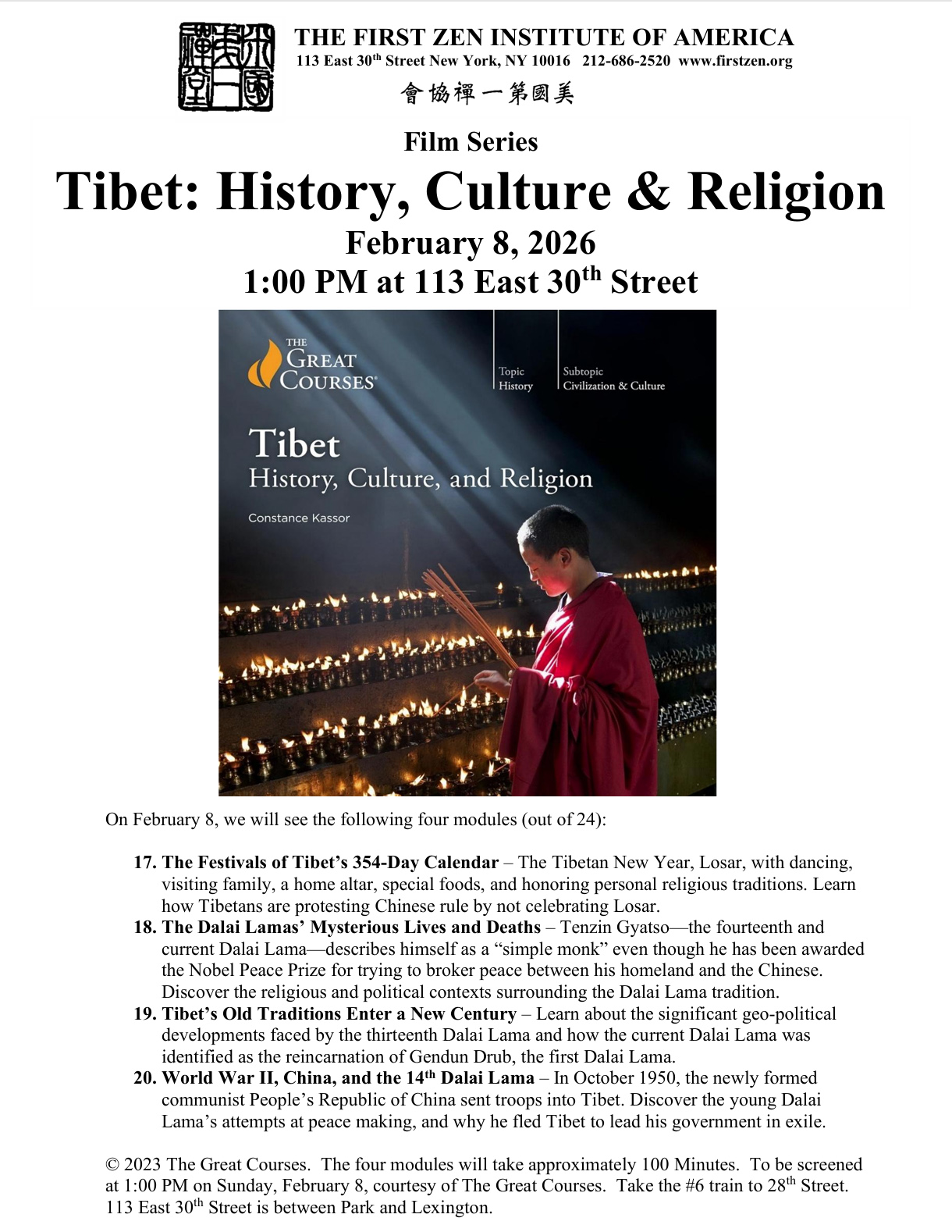 Tibet: History, Culture and Religion, Modules 17-20
 Tibet: History, Culture and Religion, Modules 13-16
 Greek & Persian Influence on Early Buddhism
 Tibet: History, Culture and Religion, Modules 9-12
 Tibet: History, Culture and Religion, Modules 5-8
 Tibet: History, Culture and Religion, Modlues 1-4
 Zen for Nothing
 The Monk and the Gun
 Understanding Japan -- A Cultural History
 Dying to Know: Ram Dass & Timothy Leary
 Understanding Japan -- A Cultural History
 The Medicine Buddha
 Sacred Texts of the World

 Doomsday Book and Seven Wonders of the Buddhist World
 Ai-Un Hugo Makibi Enomiya-Lassalle
 The Oracle: Reflections On Self
 Mindfulness - Be Happy Now
 Sacred Texts of the World
 Jnani -- The Silent Sage of Arunachala
 Himalaya
 Sacred Texts of the World
 Sacred Texts of the World
 Sacred Texts of the World
 Sacred Texts of the World
 Sacred Texts of the World
 Download The Great Courses: Buddhism Screening Notice